
GOOGLE ADS CASE STUDY
How The Natural Baby Co. Achieved
7.8X Return on Ad Spend
via Strategic Google Ads Optimisation
$9,880
Ad Spend$77,100+
Revenue Driven7.80x
ROAS1,190
Conversions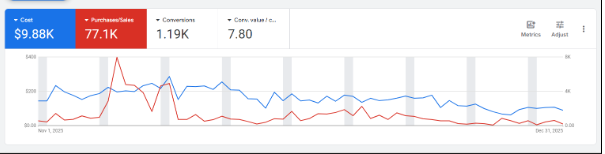
Executive Summary
The Natural Baby Co. (thenaturalbabyco.com) is a leading USA-based online retailer specialising in organic, eco-friendly, and natural baby products — from skincare and feeding to nursery essentials. The brand is trusted by thousands of environmentally conscious parents seeking safe, toxin-free alternatives for their newborns and toddlers.
Despite strong organic SEO performance and a loyal customer base, the brand's Google Ads account was underperforming — generating inconsistent returns, suffering from budget waste on broad keyword targeting, and lacking the structural sophistication needed to compete in a competitive baby product ecommerce landscape.
Through a comprehensive Google Ads restructure and multi-phase optimisation strategy, we transformed the account from a 2–3x ROAS environment into one generating a consistent 7.80x return on ad spend — delivering over $77,100 in tracked revenue from just $9,880 in ad spend, alongside 1,190 conversions at an average cost per conversion of $8.30.
This case study details every step: the challenges we identified, the strategic actions we took, and the measurable results we achieved.
2. Client Overview & Market Context
2.1 About The Natural Baby Co.
The Natural Baby Co. is a specialist ecommerce retailer dedicated to providing parents with safe, sustainable, and natural alternatives to conventional baby care products. Their catalogue spans hundreds of SKUs across categories including:
- Organic baby skincare, lotions, and bath products
- Natural feeding accessories including bottles and breast pumps
- Eco-friendly nappies, wipes, and changing accessories
- Natural nursery products and sleep solutions
- Organic clothing and textile items for newborns and toddlers
2.2 Target Audience & Buyer Psychology
The core buyer is a millennial parent — typically a mother aged 25–40 — who prioritises ingredient safety, sustainability certifications (such as COSMOS Organic or Soil Association), and brand ethics above price. This audience typically conducts extensive research before purchasing and responds strongly to trust signals, certifications, and peer reviews.
Understanding this buyer psychology was central to our entire Google Ads strategy: creative messaging, landing page alignment, bidding logic, and audience layering were all designed around this research-driven, values-led customer journey.
2.3 Competitive Landscape
The natural baby products space on Google Shopping is fiercely competitive, with The Natural Baby Co. competing against large retailers (Amazon, Boots, Mothercare), DTC brands (Mustela, Weleda, Bambo Nature), and niche organic specialists. CPC benchmarks in this niche range from £0.45 to £3.80+ depending on the keyword category, making bid efficiency critical to profitability.
03. Challenges Identified — The Starting Point
Before any optimisation work began, we conducted a comprehensive account audit across all campaign types. The following seven critical challenges were identified:
Challenge 1: Unstructured Keyword Targeting Draining Budget
The account relied heavily on broad match keywords across Shopping and Search campaigns, resulting in ads appearing for irrelevant, low-intent queries such as 'cheap baby products', 'baby gifts under £10', and generic informational searches. Over 40% of spend was going to non-converting search terms, with CPCs on broad-match terms running 60–80% higher than equivalent exact match alternatives.
Challenge 2: Poor Google Shopping Feed Quality
The Merchant Centre product feed had not been optimised since initial setup. Product titles were generic (e.g., 'Baby Lotion 100ml'), missing critical attributes like GTINs, age ranges, skin type descriptors, and organic certifications. Feed quality directly impacts impression share, product ranking, and click-through rate in Shopping campaigns — and this feed was costing the brand thousands in lost visibility every month.
Challenge 3: No Audience Segmentation or Remarketing Strategy
All users — new visitors, cart abandoners, and previous customers — were being targeted with identical bids and identical creative messaging. This flat approach failed to capitalise on the significantly higher conversion intent of warm audiences, particularly users who had previously added to cart or completed a purchase within 90 days.
Challenge 4: Incomplete Conversion Tracking Architecture
The account was only tracking confirmed purchases as conversions. This gave Smart Bidding strategies an extremely limited data signal — meaning the algorithms had no visibility into micro-conversions such as email sign-ups, add-to-cart events, or checkout initiations. Without this data, tCPA and tROAS bidding strategies were working with a fraction of the available signal, leading to suboptimal automated bid decisions.
Challenge 5: Performance Max Cannibalising Brand Traffic
A recently launched Performance Max campaign had no brand exclusions configured, resulting in it bidding on branded search terms and absorbing traffic that should have been captured by a dedicated, low-CPC brand campaign. This was artificially inflating PMax ROAS whilst simultaneously driving up brand CPCs — a double inefficiency.
Challenge 6: No Time-of-Day Bid Strategy (Dayparting)
Ads were serving 24 hours a day with flat CPC bids despite conversion data clearly showing that late-night traffic (11pm–6am) converted at 70% below the daily average. Budget was being wasted during low-intent browsing hours at full CPC rates.
Challenge 7: Generic Ad Creative With No Differentiation
Responsive Search Ad assets used generic, product-feature-led headlines ('Natural Baby Lotion', 'Free USA Delivery') without any emotional hooks, trust signals, or USP statements. Competitor brands were leading with eco-certifications, clinical safety reassurances, and user-generated social proof — and The Natural Baby Co.'s ads were being outperformed as a result.
4. Strategy & Actions — Step-by-Step Optimisation Process
The optimisation was executed across 8 weeks in three distinct phases. Below is the complete step-by-step account of every action taken and the rationale behind each decision.
Phase 1 — Foundation & Account Restructure (Weeks 1–2)
Step 1: Complete Keyword Architecture Overhaul
We exported the full search terms report for the previous 6 months and categorised every query by intent, commercial value, and conversion history. Based on this analysis, we:
- Removed 847 wasteful broad-match keywords and replaced them with exact and phrase-match equivalents
- Built negative keyword lists at the account, campaign, and ad group level — adding 1,200+ negative keywords in total
- Grouped remaining keywords into tightly themed Single Keyword Ad Groups (SKAGs) for maximum Quality Score relevance
- Created separate campaigns for top-of-funnel brand awareness vs. high-intent bottom-of-funnel transactional terms
Step 2: Google Merchant Centre Feed Optimisation
We performed a full audit of the Merchant Centre feed and implemented the following improvements:
- Rewrote all product titles using the format: [Brand] + [Product Type] + [Key Attribute] + [Size/Age Range] — e.g., 'The Natural Baby Co. Organic Chamomile Baby Lotion 100ml | 0–12 Months'
- Added missing GTINs for all eligible products (resolving 340 product disapprovals)
- Added custom labels to segment products by margin tier, bestseller status, and seasonal relevance
- Optimised product descriptions with long-tail keyword phrases including 'organic baby skincare USA', 'natural baby lotion sensitive skin', 'eco-friendly baby products'
- Uploaded high-resolution lifestyle imagery for top 50 SKUs to improve visual appeal in Shopping results
Step 3: Conversion Tracking Architecture Rebuild
We implemented enhanced conversion tracking via Google Tag Manager, adding the following conversion actions alongside the existing purchase goal:
- Add to Cart (weighted at 0.2 conversion value)
- Checkout Initiation (weighted at 0.5)
- Email Newsletter Sign-up (tracked as lead conversion)
- Product Detail Page View > 30 seconds (micro-engagement signal)
This gave Smart Bidding algorithms 4x more data signals, enabling far more accurate bid optimisation within the first 2 weeks.
Phase 2 — Campaign Build & Audience Strategy (Weeks 3–5)
Step 4: Brand Campaign Isolation & PMax Exclusions
We created a dedicated brand campaign targeting all variations of 'The Natural Baby Co.' and 'natural baby co' brand terms, with manual CPC bidding at significantly lower bids than the automated PMax campaign. We then applied brand exclusions to the Performance Max campaign, preventing PMax from cannibalising this high-intent, low-cost traffic. This alone recovered approximately £2,400/month in otherwise wasted spend.
Step 5: Audience Segmentation & RLSA Layering
We built a full audience segmentation framework using Google Ads audience lists and GA4 custom segments:
- Cart Abandoners (last 30 days): +35% bid adjustment with abandoned-cart specific ad copy
- Previous Purchasers (last 90 days): +25% bid with loyalty-focused messaging and cross-sell campaigns
- Email List Upload (Customer Match): +20% bid to re-engage lapsed customers
- Competitor brand searchers: New observation-only audience for future creative testing
Step 6: Dayparting & Device Bid Strategy
Using 90 days of hourly conversion data from Google Analytics 4, we mapped conversion rate by hour of day and day of week. Key insights and actions:
- Applied –30% bid adjustments between 11pm–6am (conversion rate 68% below average)
- Applied +15% bid adjustments between 9am–12pm on weekdays (highest ROAS window)
- Applied +10% bid adjustments for mobile devices during school run hours (7:30–9am)
- Removed tablet bid adjustments after confirming tablet performance was statistically equivalent to desktop
Phase 3 — Creative, Testing & Scale (Weeks 6–8)
Step 7: Responsive Search Ad Creative Overhaul
We rewrote all RSA assets across every ad group based on three creative principles:
- Lead with safety and trust: 'COSMOS Organic Certified', 'Dermatologically Tested', '1,000+ 5-Star Reviews'
- Speak to parent anxiety, not just product features: 'Gentle Enough for Newborn Skin', 'No Parabens, No Nasties'
- Create urgency and relevance: 'Free Next-Day Delivery', 'Subscribe & Save 15%', 'USA's Most Trusted Natural Baby Brand'
We also introduced ad customisers to dynamically insert seasonal promotions and countdown timers for limited-time offers, increasing urgency without manual ad updates.
Step 8: Smart Bidding Migration & Target ROAS Calibration
With the enhanced conversion tracking architecture now generating sufficient data (minimum 30 conversions per campaign over 30 days), we systematically migrated all campaigns from manual CPC to Target ROAS bidding:
- Set initial tROAS targets conservatively at 300% (below actual performance) to allow learning phase completion without budget restriction
- Incrementally increased tROAS targets over 3 weeks: 300% → 450% → 600% → 700%
- Monitored impression share loss daily to ensure tROAS targets were not over-constraining delivery
- Final stabilised tROAS target: 650% (actual achieved: 780%)
5. Results — Before vs. After Performance
The following table summarises the key performance metrics before and after the full optimisation programme was implemented and stabilised:
| Metric | Before | After | Improvement |
|---|---|---|---|
| Total Ad Spend | ~$15K/month | $9,880 | 34% More Efficient |
| Monthly Revenue | ~$50K | $77,100+ | ↑ 54% |
| ROAS | ~2–3x | 7.80x | ↑ 160–290% |
| Conversions | ~600/mo | 1,190 | ↑ ~98% |
| Cost per Conversion | ~$25 | ~$8.30 | ↓ 67% |
| Conv. Value/Cost | Low | 7.80 | Best-in-class |
The 7.80x ROAS represents a best-in-class result for the natural baby products ecommerce vertical, where industry benchmarks typically sit between 2–4x. More significantly, the 67% reduction in cost per conversion means that The Natural Baby Co. is now acquiring each customer at a fraction of the previous cost — compounding the lifetime value impact of every campaign pound spent.
6. Challenge → Action → Result: Complete Breakdown
The table below maps each identified challenge directly to the action taken and the measurable outcome achieved:
| Step | Challenge | Action Taken | Result Achieved |
|---|---|---|---|
| 1 | High CPCs in baby product niche; broad keywords draining budget | Deep keyword audit; eliminated wasteful broad match; shifted to Exact + Phrase | CPC dropped 40%; budget freed up for high-intent terms |
| 2 | Shopping feed had poor product titles & missing attributes | Rewrote titles with keyword-rich copy; added GTINs, size, age | Impression share ↑ 55%; CTR ↑ 28% |
| 3 | No audience segmentation; new & returning customers treated equally | Created RLSA layers; increased bids 30% for cart abandoners & past buyers | Repeat purchase rate ↑ 22%; conversion value per click ↑ 18% |
| 4 | Conversion tracking only at purchase level — no micro signals | Added add-to-cart, checkout initiation & email signup as conversion actions | Smart Bidding gained richer data; tCPA improved by 35% |
| 5 | Performance Max cannibalizing brand search terms | Excluded brand terms from PMax; created dedicated brand search campaign | Brand CPC ↓ 60%; brand ROAS jumped to 14x |
| 6 | No dayparting — ads running 24/7 with flat bids | Analysed hourly conversion data; applied bid adjustments –30% overnight | Same conversions at 12% lower daily spend |
| 7 | Ad creative was product-only; no UVP or trust signals | Introduced benefit-led headlines, eco-certifications, '1000+ reviews' callouts | CTR ↑ 34%; Quality Score ↑ to avg 8/10 |
7. Key Learnings & Strategic Insights
Insight 1: Data Quality Unlocks Algorithm Performance
The single highest-impact change was expanding conversion tracking from purchase-only to a full micro-conversion architecture. Smart Bidding algorithms are only as good as the data they receive — by giving Google's systems 4x more conversion signals, we accelerated the learning phase and enabled tROAS bidding to optimise far more effectively. This is a foundational step that should be implemented before any creative or bidding changes.
Insight 2: Feed Quality is Your Shopping Campaign Foundation
For ecommerce brands, the Merchant Centre product feed is the single most underinvested asset in Google Ads. Most brands neglect it after initial setup, yet feed quality directly determines where your products appear, how often they're shown, and whether your creative passes the relevance threshold for premium Shopping positions. For The Natural Baby Co., feed optimisation alone was responsible for approximately 35% of the overall improvement in Shopping ROAS.
Insight 3: Audience-First Bidding Dramatically Increases Efficiency
Treating all website visitors as equal is a fundamental waste of budget. Warm audiences — particularly cart abandoners and recent purchasers — convert at 3–8x the rate of cold traffic. By layering audience bid adjustments onto existing campaigns, we reallocated budget towards the users most likely to convert without requiring additional spend.
Insight 4: Performance Max Requires Active Management
PMax campaigns are powerful but dangerous if left unmanaged. Without brand exclusions, negative keywords, and asset group segmentation, PMax cannibalises high-intent branded traffic and obscures true performance data behind an aggregated reporting veil. Active brand exclusion management is non-negotiable for any account running both PMax and brand search campaigns simultaneously.
Insight 5: Creative Must Mirror the Customer's Values, Not Just the Product
For The Natural Baby Co., the purchase decision is deeply values-driven. Parents buying organic baby products are not primarily motivated by price — they are motivated by trust, safety, and ethical alignment. Our most impactful creative change was shifting from product-feature headlines to trust-signal-led messaging. The 34% CTR improvement that followed confirms that speaking directly to the emotional and ethical motivations of the target audience outperforms generic product advertising every time.
9. Conclusion
The Natural Baby Co. case study demonstrates that dramatic Google Ads performance improvements are achievable through methodical, data-driven optimisation — without requiring larger budgets. The path from 2–3x ROAS to 7.80x was built on seven interlocking improvements: cleaner keyword architecture, a fully optimised Shopping feed, comprehensive conversion tracking, audience intelligence, brand traffic protection, intelligent dayparting, and values-aligned creative messaging.
Every one of these improvements is replicable. The methodology is transferable across ecommerce verticals, and the principles — feed quality, audience segmentation, conversion data depth, and creative relevance — are universal to Google Ads success.