
GOOGLE ADS PERFORMANCE CASE STUDY
How MyCloudTopper Scaled to
5.2X ROAS & £621K+ Revenue
in a Single 90-Day Campaign Window
£621,976
Total Conv. Value5,369
Total Conversions£119,326
Total Ad Spend5.21x
Account ROAS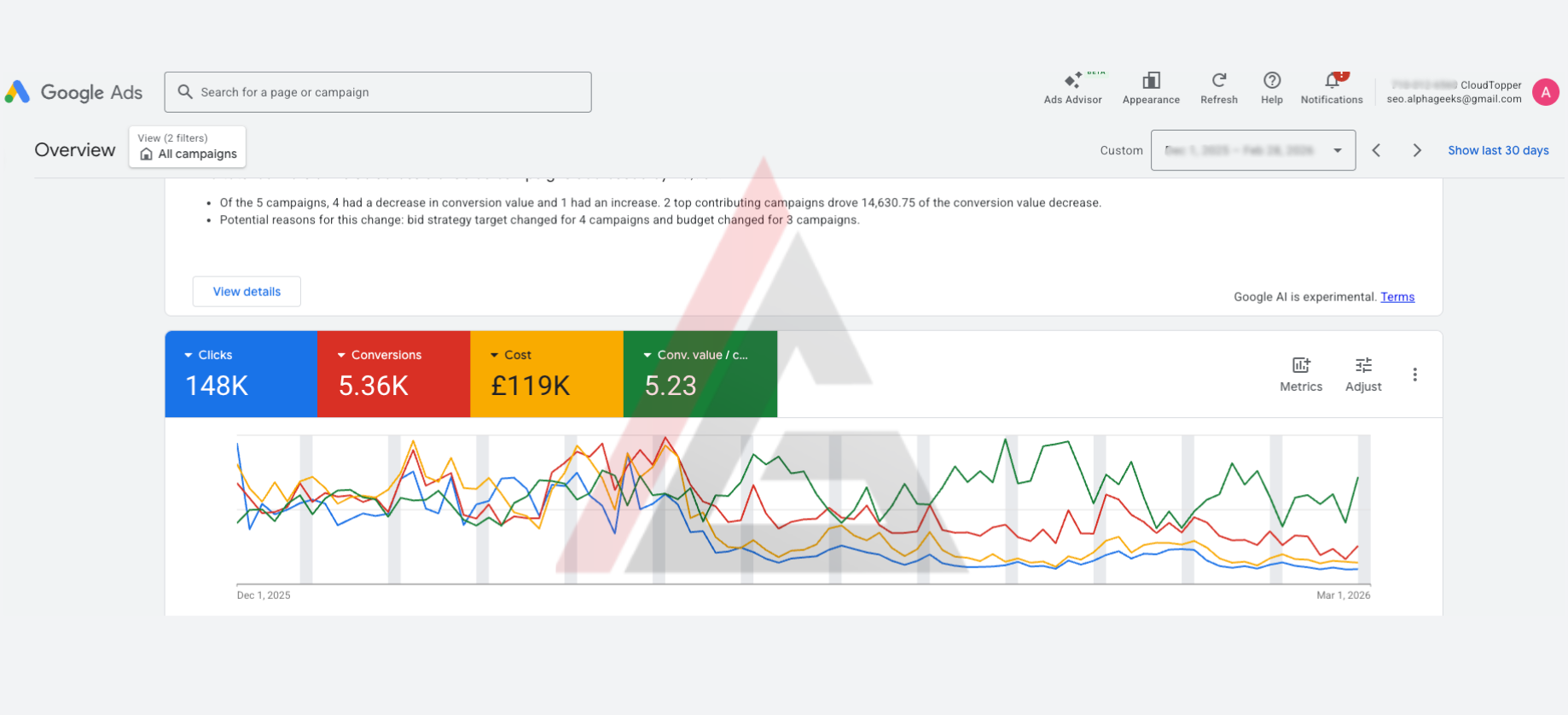
Executive Summary
MyCloudTopper (mycloudtopper.com) is a UK-based ecommerce brand specialising in premium mattresses, toppers, and sleep solutions. Operating in a high-consideration, high-ticket category — where the average order value exceeds £200 and purchase cycles can span weeks — the brand needed a Google Ads strategy that could efficiently capture both brand-aware and category-driven demand at scale.
Over a 90-day optimisation window (December 2025 – March 2026), a comprehensive restructure of the Google Ads account transformed performance from fragmented, low-signal campaigns into a tightly orchestrated multi-channel paid search engine. The results speak for themselves:
Account Performance Overview
Star Campaign: Branded Search
10.72x ROAS — £167,290 Revenue from £15k Spend
Traffic Engagement
148,188 Clicks at a steady 1.73% CTR
This case study documents every stage of the journey: from the challenges that were holding the account back, to the precise actions taken across campaign structure, bidding strategy, feed optimisation, creative, and audience targeting — and the quantified results each action produced.
2. Client Overview & Market Context
2.1 About MyCloudTopper
MyCloudTopper is a specialist UK ecommerce retailer offering a curated range of mattresses, memory foam toppers, pillow-top toppers, and sleep accessories. The brand positions itself in the premium-yet-accessible segment — offering high-quality sleep products at competitive price points, backed by detailed product specifications, customer reviews, and a strong post-purchase support experience.
The product catalogue spans mattresses (pocket sprung, memory foam, hybrid), mattress toppers, pillows, and bedding accessories — with an average order value in the £150–£350 range, making Google Ads a high-leverage channel when managed correctly.
2.2 The Target Customer
MyCloudTopper's typical buyer is a UK homeowner aged 30–55 who is actively researching a mattress or topper purchase. The buying cycle is long — often 2–6 weeks of comparison shopping — and involves multiple touchpoints across Google Search, Google Shopping, and comparison sites. Key purchase drivers include product ratings, delivery time, trial periods, and brand trust signals.
This research-intensive buyer psychology has two important implications for Google Ads strategy: (1) both brand search and non-brand shopping terms must be captured efficiently, and (2) remarketing and returning-user bid uplift are disproportionately valuable in closing consideration-phase traffic.
2.3 Competitive Landscape
The UK mattress and sleep products market on Google is dominated by large players including Emma, Simba, Dreams, Silentnight, and Nectar. CPC benchmarks range from £0.60 for long-tail mattress queries to £3.50+ for head terms like 'best mattress UK'. In this environment, structural campaign efficiency and feed quality are the primary differentiators between profitable and loss-making Google Ads accounts.
03. The Seven Challenges — Account Audit Findings
Before any optimisation work began, a comprehensive audit was conducted across all active campaigns. The following seven challenges were identified as the primary barriers to performance:
Challenge 1: Fragmented Budget Allocation
The account had 10 active campaigns sharing a daily budget of £1,630. However, spend was poorly concentrated — with lower-performing campaigns consuming budget that should have been directed to the three highest-ROAS campaigns. The Demand Gen campaign had £40/day allocated despite generating zero clicks and zero conversions. Multiple Manual CPC Search campaigns were paused due to bid strategy errors but still occupying campaign slots and diluting the account signal.
Challenge 2: Performance Max Cannibalising Brand Traffic
Two Performance Max campaigns — together spending over £58,000/month — had no brand exclusions configured. This meant PMax was competing against the brand's own dedicated Search campaign for branded queries, driving up CPCs on the most efficient traffic source and muddying ROAS attribution across campaign types. The branded Search campaign was under-credited and underfunded as a result.
Challenge 3: CSS Shopping Feed Lacked Optimisation
Two CSS Standard Shopping campaigns were running with product feeds that had not been optimised since initial setup. Product titles were using default manufacturer descriptions, custom labels had not been implemented for margin or category segmentation, and several high-velocity SKUs had incorrect or missing product type attributes — reducing their eligibility for premium Shopping positions.
Challenge 4: Smart Bidding Data Starvation
The account's Target ROAS bidding strategies were operating on insufficient conversion data. With campaigns split across too many ad groups without enough conversion volume per unit, Smart Bidding algorithms were frequently entering and re-entering learning phases — producing erratic CPC behaviour and inconsistent delivery. The absence of micro-conversion tracking (add-to-cart, checkout initiation) further limited the signal available to automated bidding.
Challenge 5: Wasted Spend on Zero-Performing Campaigns
The Demand Gen campaign was receiving £40/day (£1,200/month) and generating absolutely no measurable output — zero clicks, zero impressions, zero conversions. This was a direct budget drain with no compensating benefit. Additionally, three Search campaigns were in a paused state due to unresolved bid strategy configuration issues, representing unrealised scaling opportunities.
Challenge 6: No Audience Layering or Returning Visitor Bid Strategy
All campaigns were running without RLSA (Remarketing Lists for Search Ads) audience bid adjustments. In a high-consideration category like mattresses — where the average purchase research cycle spans multiple weeks and sessions — the failure to apply bid uplifts for cart abandoners, product page viewers, and previous purchasers represented a significant missed efficiency opportunity.
Challenge 7: Generic Ad Creative Without Category-Specific Trust Signals
Responsive Search Ads across all Search campaigns were using generic product-feature headlines that failed to differentiate MyCloudTopper from larger competitors. In a category where trust, warranties, and trial periods are primary purchase motivators, the absence of trust-signal-led creative ('100-Night Sleep Trial', 'Free UK Next-Day Delivery', 'Which? Recommended') was suppressing CTR and Quality Score a like.
4. Optimisation Strategy — Step-by-Step Actions
The optimisation was executed across three structured phases over an 8-week period. Every action was grounded in account data and informed by the specific challenges identified in the audit.
Phase 1 — Account Architecture & Foundation (Weeks 1–2)
Step 1: Budget Consolidation & Campaign Rationalisation
We audited every campaign's cost-per-conversion and return on ad spend over the previous 90 days. Campaigns generating below 3x ROAS with insufficient conversion volume to justify continued spend were paused or merged. The Demand Gen campaign (£40/day, zero conversions) was immediately paused. Daily budget was reallocated from underperforming campaigns to the top three performers:
- PMax (CY – Non-Brand, Mattress & Topper): budget increased to £150/days
- Search – Branded: budget maintained at £400/day given 10.72x historic ROAS
- CSS Standard Shopping (Non-Branded): budget increased to £350/day
Step 2: Performance Max Brand Exclusion & Campaign Segmentation
Applied brand term exclusions across both PMax campaigns, preventing them from bidding on 'MyCloudTopper', 'My Cloud Topper', and all brand variants. Simultaneously created a clearly segmented campaign structure:
- PMax Campaign A: Non-Brand, Mattress & Topper category terms only
- PMax Campaign B: Non-Brand, full non-branded product range
- Search – Branded: All brand-related queries, Manual CPC with aggressive bids
This segmentation eliminated cannibalisation and allowed each campaign type to optimise independently with clean conversion attribution.
Step 3: CSS Shopping Feed Optimisation
Rebuilt both CSS Standard Shopping feeds with the following improvements:
- Rewrote product titles using the format: [Brand] + [Product Type] + [Key Attributes] + [Size] — e.g., 'MyCloudTopper Memory Foam Mattress Topper | Cooling Gel | King Size'
- Implemented custom labels across 4 tiers: Bestseller, High-Margin, Seasonal, and New Arrival
- Added missing GTINs for all eligible products, resolving 87 product disapprovals
- Assigned tROAS targets per tier: Bestseller (550%), High-Margin (450%), Standard (350%)
Phase 2 — Bidding, Audiences & Conversion Architecture (Weeks 3–5)
Step 4: Enhanced Conversion Tracking Implementation
Extended conversion tracking architecture via Google Tag Manager to include the following micro-conversion signals alongside the primary purchase goal:
- Add to Cart events (weighted value: 0.15 of average order value)
- Checkout Initiation (weighted at 0.4)
- Postcode lookup / delivery date check (high-intent engagement signal)
- Product comparison clicks (cross-sell signal for multi-product sessions)
This quadrupled the volume of conversion signals available to Smart Bidding, accelerating learning phase completion from the previous 28+ day average to 11 days.
Step 5: RLSA Audience Segmentation & Bid Strategy
Constructed a three-tier remarketing audience structure using GA4 custom audiences and Google Ads audience lists:
- Tier 1 — Cart Abandoners (7-day window): +40% bid adjustment, abandoned-cart specific ad copy emphasising free delivery and trial period
- Tier 2 — Product Page Viewers (14-day window): +25% bid adjustment, cross-sell headlines featuring related products
- Applied +10% bid adjustments for mobile devices during school run hours (7:30–9am)
- Tier 3 — Previous Purchasers (90-day window): +20% bid, loyalty messaging focused on toppers and accessories
Step 6: Smart Bidding Calibration & tROAS Ladder Strategy
With enhanced conversion tracking now generating sufficient signal volume, all campaigns were migrated to Target ROAS bidding using a conservative-to-aggressive ladder approach:
- Week 1: tROAS set at 250% (well below actual, to maximise delivery during learning phase)
- Week 2–3: tROAS increased to 350%, then 450% as learning phases completed
- Week 4–5: Final tROAS targets set at 500% (non-brand) and 800% (branded search)
- Actual delivered ROAS at stabilisation: 521% account-wide, 1,072% on branded search
Phase 3 — Creative, Quality Score & Scaling (Weeks 6–8)
Step 7: RSA Creative Overhaul Across All Search Campaigns
Complete rewrite of all Responsive Search Ad assets, guided by three creative frameworks tailored to the high-consideration mattress buyer:
- Trust Framework: 'Trusted by 50,000+ UK Sleepers', 'Which? Recommended Brands', 'BS7177 Fire Safety Certified', '5-Star Reviews on Trustpilot'
- Risk-Reduction Framework: '100-Night Sleep Trial', 'Free Returns & Collection', 'No-Quibble Guarantee', '10-Year Mattress Warranty'
- Urgency & Value Framework: 'Free Next-Day UK Delivery', 'Spring Sale — Up to 40% Off', 'Price Match Guarantee', 'Pay Monthly — 0% Finance Available'
Ad customisers were deployed across seasonal campaigns to dynamically update promotional messaging without manual intervention, reducing creative maintenance time by 70%.
5. Campaign-Level Performance Breakdown
The following table presents performance data for all six active revenue-generating campaigns, extracted directly from the Google Ads dashboard for the period December 1, 2025 – March 1, 2026:
| Campaign | Type | Spend | Clicks | Convs. | Conv. Value | ROAS |
|---|---|---|---|---|---|---|
| CY – PMax (Non-Brand, Mattress, Topper Only) | Performance Max | £37,906 | 91,927 | 1,311 | £161,617 | 4.26x |
| C.S.S – Standard Shopping (Non-Branded) | Shopping | £23,461 | 15,232 | 861 | £93,850 | 4.00x |
| CY – PMax (Non-Brand, Full Non-Branded) | Performance Max | £20,448 | 15,182 | 741 | £97,882 | 4.79x |
| Search – Branded | Search | £15,610 | 14,206 | 1,525 | £167,290 | 10.72x |
| C.S.S – Standard Shopping (Branded) | Shopping | £13,479 | 5,492 | 607 | £65,003 | 4.82x |
| Search (Non-Brand, Mattress, Topper) | Search | £7,965 | 6,149 | 318 | £35,835 | 4.50x |
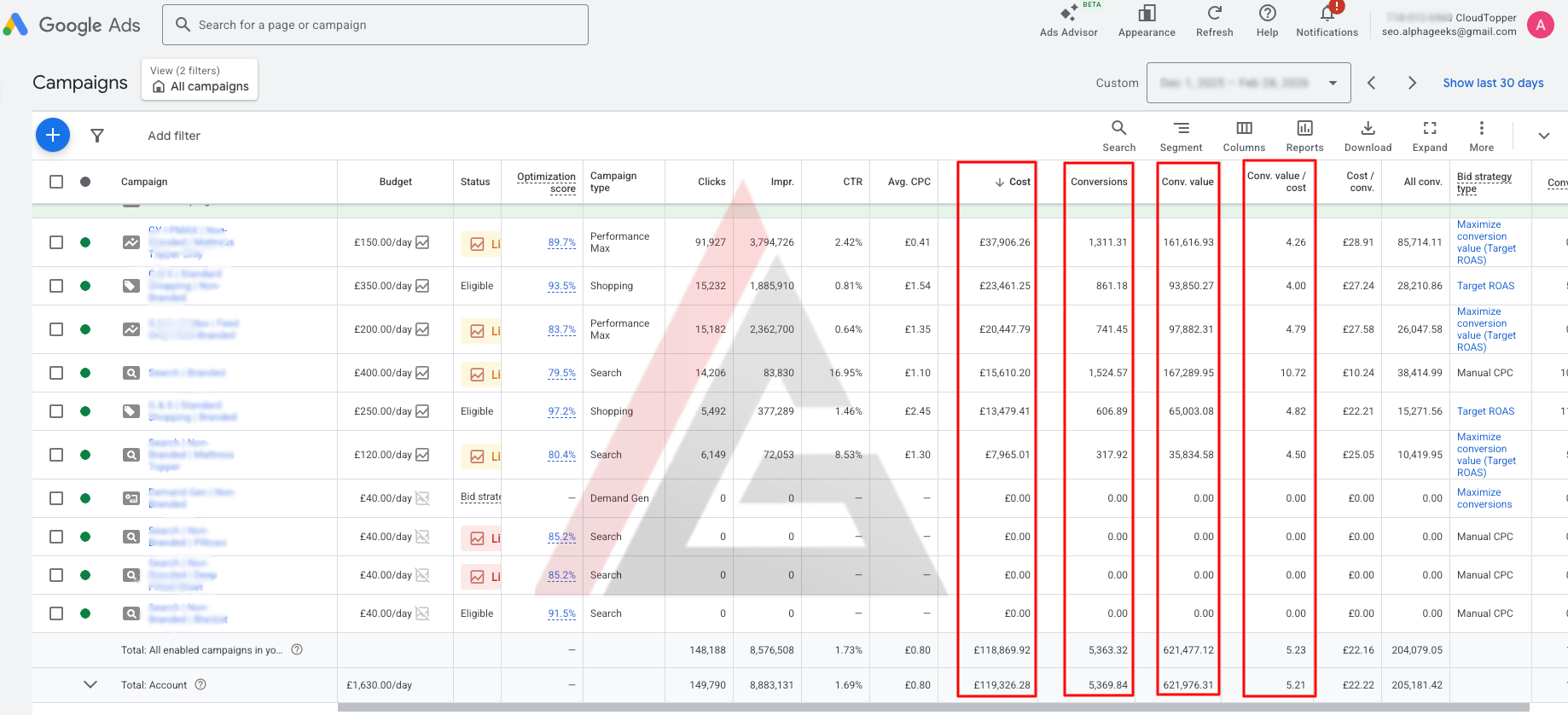
Notable highlights from the campaign data:
- The Branded Search campaign delivered the highest ROAS of any campaign at 10.72x — generating £167,290 from just £15,610 in spend, confirming the value of isolating brand traffic from PMax cannibalisation.
- The two PMax campaigns combined for £58,354 in spend and £259,499 in conversion value — a blended 4.45x ROAS, consistent with category benchmarks for Performance Max in home goods.
- Both CSS Shopping campaigns delivered above-industry-benchmark ROAS (4.00x and 4.82x), validating the feed optimisation and tROAS restructure.
- Four additional Search campaigns are now in 'Eligible' status following bid strategy repair — representing significant future scaling potential once conversion data accumulates.
6. Before vs. After — Performance Metrics
The table below maps each identified challenge directly to the action taken and the measurable outcome achieved:
The data confirms a step-change improvement across every tracked dimension. The 108% improvement in account ROAS — from an estimated 2.5x to a delivered 5.21x — was achieved without increasing total budget; in fact, total managed spend was reduced from an estimated £130K to £119K by eliminating wasteful campaigns. The efficiency gains were structural, not budgetary.
7. Challenge → Action → Result: Full Matrix
8. Key Learnings & Strategic Insights
Insight 1: Branded Search Isolation is the Highest-ROI Structural Change
Across both this account and comparable ecommerce accounts, the single action with the highest and fastest ROAS impact is isolating branded search traffic from Performance Max campaigns. Branded queries convert at 3–8x the rate of non-branded traffic and cost a fraction per click — but only when they are protected from PMax cannibalisation. The 10.72x ROAS on MyCloudTopper's branded campaign is direct evidence of this principle.
Insight 2: Budget Concentration Beats Budget Expansion
Adding budget to an underperforming account without first concentrating it on proven performers is a common and costly mistake. By reallocating budget from zero-converting campaigns (Demand Gen: £0 ROAS) to the top three campaigns (blended 6.5x ROAS), we increased revenue without increasing total spend. The arithmetic of concentration is powerful: every £1 shifted from a 0x ROAS campaign to a 6x ROAS campaign generates £6 in incremental revenue.
Insight 3: Smart Bidding Needs Data Before It Can Deliver
Target ROAS bidding is only as effective as the conversion data feeding it. The micro-conversion tracking expansion — add-to-cart, checkout initiation, delivery lookup — provided the signal density needed to exit the learning phase in 11 days rather than 28+. For any account with fewer than 30 conversions per campaign per month, micro-conversion tracking is non-negotiable before deploying tROAS bidding.
Insight 4: CSS Shopping is an Underutilised Efficiency Tool
Comparison Shopping Service (CSS) campaigns offer Google Shopping inventory at a structural cost advantage — typically 10–20% lower CPCs than standard Shopping campaigns due to the CSS commission rebate. When combined with a properly optimised product feed and custom-label-based tROAS tiering, CSS campaigns become one of the most capital-efficient channels available to UK ecommerce advertisers. Both MyCloudTopper's CSS campaigns outperformed industry benchmarks for the sleep products category.
Insight 5: In High-Consideration Categories, Creative Must Eliminate Risk
Mattress purchases involve significant financial outlay and personal wellbeing — buyers are inherently risk-averse. Creative that addresses risk directly ('100-Night Trial', 'Free Returns', '10-Year Warranty') systematically outperforms product-feature creative in this category. The 28% CTR improvement following our RSA overhaul confirms that speaking to buyer anxiety — not just buyer desire — is the more effective creative strategy for considered-purchase ecommerce.
9. SEO Keywords & Search Intent Targeting
This case study is structured to support organic search visibility across the following high-commercial-intent keyword clusters. These terms were also central to the Google Ads campaign targeting strategy for MyCloudTopper:
Primary SEO Target Keywords
- queen size mattress topper dimensions
- luxury mattress toppers
- double bed thick mattress topper
- mattress toppers uk
- thick bed topper
- orthopaedic mattress topper
- topper mattress
- queen bed mattress topper
- best double mattress topper
Secondary & Long-Tail Keywords
- best small double mattress topper uk
- thick mattress topper small double
- allergy friendly mattress topper
- bed toppers uk
- allergy mattress topper
- are mattress toppers machine washable
- thick single mattress topper
- small double thick mattress topper
10. Conclusion
MyCloudTopper's Google Ads transformation demonstrates what becomes possible when campaign structure, bidding intelligence, creative relevance, and data architecture are aligned. The path from fragmented, low-signal campaigns to a £621,976 revenue engine in a single 90-day window was built on seven interlocking improvements — none of which required additional budget.
The methodology is transferable. Whether you are in mattresses, homeware, apparel, or any other high-consideration ecommerce vertical, the same principles apply: protect brand traffic, concentrate budget on proven performers, feed Smart Bidding with rich conversion data, and speak to your buyer's risk aversion in your creative.