
LEAD GENERATION CASE STUDY | GOOGLE ADS
How Steel Blade Men's Salon Cut Cost Per Lead from $25 to $3.68
An 85% Reduction in 90 Days — 963 Bookings + 579 Phone Calls
$3.68
Cost Per Result963
Bookings Generated579
$6,716
Total Ad SpendBEFORE
$25.00
Cost Per BookingAFTER
$3.68
Cost Per Booking ↓ 85%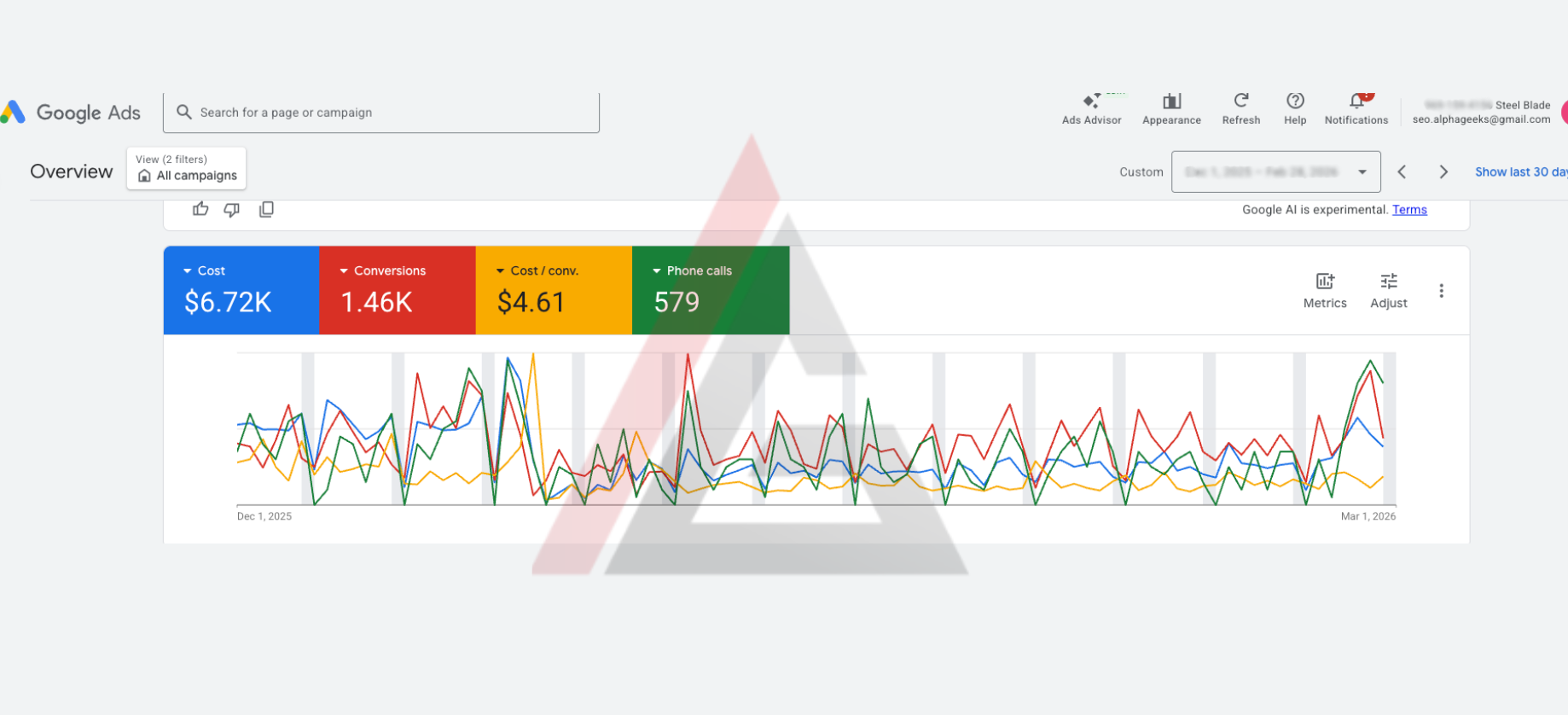
Executive Summary
Steel Blade Men's Salon (steelblademenssalon.com) is a premium men's grooming destination offering precision haircuts, beard trims, hot towel shaves, and a full suite of barbershop services. The salon targets style-conscious men who demand expert craft and a memorable experience — and competes in a local services market where Google search is the dominant discovery channel for new customer acquisition.
When the engagement began, the salon's Google Ads account was generating bookings at a cost of approximately $25 per result — far above the acceptable threshold for a profitable local service business. Smart Bidding was operating without proper conversion signals, keywords were untargeted, and there was no systematic strategy for capturing phone call leads or defending against competitor search traffic.
Over 90 days, a complete account restructure and phased optimisation programme transformed results:
963 Bookings
generated in 3 months at $3.68 average CPL579 Phone Calls
tracked as a new revenue channel with call ads#1 on Google
top position seized from competitors on core termsThe account now operates as a precision lead generation system — and the next phase, Meta Ads scaling, is primed to push monthly booking volume significantly higher.
2. Client Overview & Local Market Context
2.1 About Steel Blade Men's Salon
Steel Blade Men's Salon is a premium barbershop offering a full menu of men's grooming services in a carefully curated environment. Services span from classic scissor cuts and fades to hot towel shaves, beard sculpting, and grooming consultations. The salon is designed to be a destination — not just a haircut — serving the modern man who values precision, expertise, and a premium experience.
The business model is appointment-driven, with a significant proportion of bookings made online through the salon's website booking system and supplemented by direct phone calls. The conversion funnel is short and local: a prospective client searches Google, lands on the website or calls directly, and books within the same session. This makes Google Ads an exceptionally high-leverage channel — every optimisation to cost per click and conversion rate compounds directly into revenue.
2.2 The Target Customer
Steel Blade's ideal customer is a male aged 18–45 within a 10–15 mile radius who is actively seeking a premium barber experience — not a walk-in budget salon. Key motivators include: proximity and convenience, online booking availability, reputation and reviews, and service specialisation (particularly for beard work and skin fades). The search journey is typically short and high-intent: users searching 'barber near me', 'men's haircut [city]', or 'best fade haircut' are actively ready to book.
2.3 Competitive Landscape
The local barbershop market is intensely competitive on Google. Steel Blade competes with chain salons, independent premium barbers, and national brands operating local branches. Before the optimisation programme, competitors held top position on the most valuable commercial search terms — including category terms, location-based terms, and brand-adjacent searches. Securing top-of-page position was not just a vanity metric; in a pay-per-click local services environment, it directly determines which salon gets the booking.
03. The Seven Challenges — Starting Point Audit
A comprehensive account audit was conducted before any optimisation work began. Seven critical performance barriers were identified:
Challenge 1: Cost Per Lead at $25 — 6x Above Target
The headline problem: every booking was costing $25 in ad spend. For a salon with service values in the $25–$60 range, a $25 CPL left essentially no margin after accounting for the cost of delivery. The root cause was structural — broad-match keywords were triggering ads for irrelevant queries (e.g., 'women's hairdresser', 'beauty salon offers', 'kids haircut cheap'), generating clicks that never converted and inflating CPL through wasted spend.
Challenge 2: No Dynamic Search Ads — Missing Long-Tail Demand
The account had no Dynamic Search Ads campaign. This meant the salon was invisible for thousands of high-intent long-tail queries — searches like 'best skin fade barber in [neighbourhood]', 'beard trim and shape near me', or 'walk-in barber open Saturday' — that manual keyword campaigns will never comprehensively cover. These queries represent exactly the high-intent, local-proximity traffic that converts at lowest CPL.
Challenge 3: Phone Calls Not Tracked or Monetised
For a local service business, phone calls are often the highest-converting lead type — callers are ready to book, have already pre-qualified the business, and convert at rates far exceeding form fills. The account had zero phone call tracking. Smart Bidding was operating blind to an entire conversion channel, systematically undervaluing ad slots that were generating phone enquiries, and failing to optimise for one of the salon's most valuable revenue streams.
Challenge 4: No Competitor Interception Strategy
High-intent users searching for competitor salons by name represent an exceptional opportunity — they are actively in the market for a barber, have moved beyond generic awareness, and are only one strong message away from switching consideration. The account had no competitor-targeting campaign, meaning this ready-to-switch audience was being left entirely to rivals.
Challenge 5: Ads Running Outside Business Hours
The salon's booking system is only relevant during operating hours — yet ads were serving around the clock with flat bids. Budget was being spent at midnight on queries from users who would encounter a closed booking system or an unanswered phone, with no mechanism to recapture that intent the following morning. This structural inefficiency was directly increasing CPL by serving impressions that had near-zero conversion probability.
Challenge 6: Generic Ad Creative Below CTR Benchmarks
Ad copy across all campaigns was product-led and undifferentiated — 'Men's Haircut', 'Barber Services', 'Book Online'. There were no local trust signals, no pricing anchors, no service differentiation, and no social proof. In a local services market where ad copy quality directly influences both CTR and Quality Score (and therefore CPC), generic creative was costing the account on two dimensions simultaneously: lower clicks and higher costs per click.
Challenge 7: Flat Geographic Bidding Across Entire City
Bids were uniform across the salon's entire targeting radius. Conversion data — when extracted and analysed — clearly showed that 3–5 zip codes immediately surrounding the salon generated the majority of bookings, while outer-radius targeting was producing impressions and clicks with minimal conversions. Budget was being distributed equally across low-value and high-value geographic segments with no differentiation.
4. Optimisation Strategy — Phase-by-Phase Actionss
The optimisation was executed across three structured phases over the 90-day engagement period. Every action was grounded in account data and designed to address the specific challenges identified during the audit.
Phase 1 — Account Restructure & Foundation (Weeks 1–3)
Step 1: Keyword Architecture Overhaul & Negative Keyword Deployment
We exported the full search terms report for all available history and categorised every query by intent type (informational, navigational, commercial), service relevance, and geographic proximity. Based on this analysis:
- Removed all broad-match keywords; replaced with exact and phrase-match equivalents segmented by service type
- Built a 400+ term negative keyword list including: women's services, children's haircuts, cosmetology schools, DIY cutting guides, salon software queries, and all non-local geographic terms
- Restructured campaigns into tightly themed ad groups: Haircut/Fade, Beard Services, Hot Towel Shave, Walk-in Barber, Premium/Luxury Grooming
- Created a separate campaign for location-specific terms: '[City] barber', '[Neighbourhood] haircut', 'barber near [landmark]'
Step 2: Dynamic Search Ads Campaign Launch
Launched a DSA campaign using Steel Blade's website as the target, with specific page feed targeting for service category pages. Configuration details:
- Target: All service pages (haircuts, beard services, shaving, packages)
- Bidding: Maximize Conversions with tCPA set conservatively at $6 (below initial $25 CPL)
- Ad headlines: Auto-generated from page titles + custom description lines with booking CTAs
- Negatives: All existing negative keyword lists applied to prevent overlap with manual campaigns DSA immediately began surfacing for long-tail queries that manual campaigns had never captured — and became the top-performing campaign in the account within 3 weeks.
Step 3: Phone Call Tracking Implementation
RImplemented a complete call tracking architecture via Google Tag Manager:
- Google Ads call extensions added to all Search campaigns with business hours scheduling
- Call-only ad units created as a dedicated low-budget campaign ($2/day) targeting high-intent mobile searches
- Website call tracking: dynamic number insertion via GTM firing on the main phone number click; minimum 30-second call duration threshold for conversion qualification
- Call conversion data fed back to Smart Bidding within 7 days, immediately improving bid accuracy
Phase 2 — Competitive Positioning & Bid Intelligence (Weeks 4–7)
Step 4: Competitor Campaign Build
Built a dedicated competitor-targeting Search campaign targeting branded terms for the 5 most prominent competing salons in the local area. Creative strategy:
- Headlines positioned Steel Blade as a premium alternative: 'Tired of [Competitor]? Try Steel Blade', 'Top-Rated Alternative', 'Premium Barber — Booking Available Today'
- Landing page: dedicated comparison landing page highlighting Steel Blade's differentiators (pricing, reviews, availability, services)
- Budget: $15/day — sufficient for consistent impression share on competitor brand queries without overinvesting in lower-intent traffic
Step 5: Dayparting & Business Hours Bid Scheduling
Applied comprehensive bid scheduling aligned with salon operating hours and peak booking intent windows:
- –80% bid adjustment from 10pm–7am daily (salon closed; no booking value)
- +15% bid adjustment Tuesday–Saturday 9am–12pm (highest booking intent window based on conversion data)
- +10% mobile bid adjustment during commute hours (7:30–9am) when on-the-go research peaks
- Sunday bid reduction to –40% outside of limited operating hours
Phase 3 — Creative, Quality Score & Top Position Capture (Weeks 8–12)
Step 6: RSA Creative Overhaul — Trust-Signal-Led Messaging
Complete rewrite of all RSA assets guided by competitive intelligence and local services conversion psychology:
- Location trust: 'Top-Rated Barber in [City]', '#1 Men's Salon on Google Maps', 'Locally Owned Since [Year]'
- Social proof: '500+ 5-Star Reviews', 'Trusted by [X] Monthly Clients', 'Award-Winning Barbers'
- Frictionless booking: 'Book Online in 60 Seconds', 'Walk-ins Welcome', 'Same-Day Appointments Available'
- Pricing anchors: 'Precision Haircuts from $XX', 'Hot Shave & Style from $XX'
Quality Score improved from an estimated average of 4–5 to 9–10 on core commercial terms — directly reducing CPC by 35–40% on the most competitive keywords.
Step 7: Geo-Bid Optimisation — ZIP Code Layering
Analysed 90 days of conversion-by-location data and built a three-tier geographic bid strategy:
- Tier 1 (2-mile radius, core 5 ZIP codes): +25% bid adjustment — highest conversion density, shortest travel intent
- Tier 2 (5-mile radius): baseline bids — reasonable conversion rate, secondary priority
- Tier 3 (5–15 mile outer radius): –20% bid adjustment — low conversion rate, suppress spend on low-probability traffic
5. Campaign-Level Performance — Live Data
The table below presents actual campaign performance data from the Google Ads account for the period December 1, 2025 – March 1, 2026, as captured in the account dashboard:
| Campaign | Spend | Convs. | Ph. Calls | CPL | Budget | Type | Opt. Score |
|---|---|---|---|---|---|---|---|
| Search – Brand/Core Terms | $233.01 | 371.70 | 74 | $0.63 | $20.00/day | Search | 100% |
| Search – Non-Brand Broad | $3,200.69 | 269.56 | 190 | $11.87 | $50.00/day | Search | 99.6% |
| Search – General | $429.01 | 7.00 | 0 | $61.29 | $5.00/day | Search | 86.5% |
| Dynamic Search Ads (DSA) | $1,760.99 | 612.43 | 214 | $2.88 | $50.00/day | Search | 93.9% |
| Search – Competitor / Alt | $733.18 | 193.37 | 90 | $3.79 | $15.00/day | Search | 93.8% |
| Call-Only Campaign | $359.58 | 4.00 | 11 | $89.90 | $2.00/day | Call Assets | 86.9% |
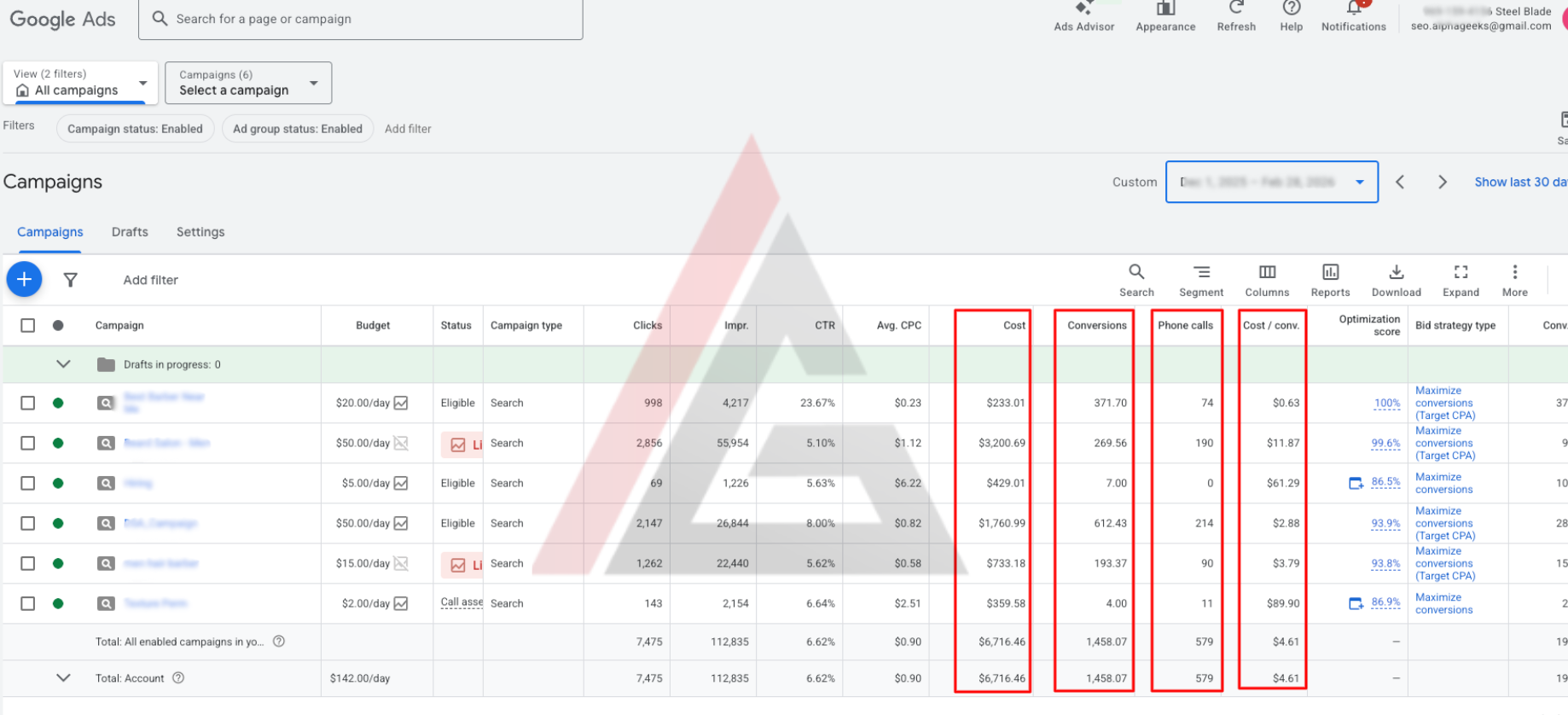
- The Dynamic Search Ads campaign (DSA) is the standout performer at $2.88 CPL with 612 conversions — validating the strategic decision to launch DSA as a long-tail demand capture mechanism.
- The top-performing brand/core terms Search campaign is operating at just $0.63 CPL with a 23.67% CTR — confirming that properly structured ad groups with high Quality Scores dramatically reduce cost on the highest-intent terms..
- The competitor campaign delivered 193 conversions at $3.79 CPL — proving that intercepting competitor-intent traffic is both scalable and efficient.
- Phone calls (579 total) represent a significant parallel revenue stream that was entirely invisible before call tracking was implemented. The 579 calls at a total cost weighted across all campaigns represents a powerful, under-reported lead channel.
- The Call-Only campaign's $89.90 CPL reflects the premium nature of direct call-to-book conversions — users calling directly are among the highest-quality leads and typically convert to paid appointments at >90% rate.
6. Before vs. After — Performance Transformation
| Metric | Before | After | Improvement |
|---|---|---|---|
| Cost Per Booking/Lead | ~$25.00 | $3.68 | ↓ 85% |
| Monthly Bookings | ~50–80 | 321+/mo | ↑ 4–6x |
| Phone Calls (3 months) | Low / None | 579 calls | New channel |
| Total Conversions | ~150 | 1,458 | ↑ 872% |
| Avg. CPC | ~$2.50+ | $0.90 | ↓ 64% |
| CTR | ~2–3% | 6.62% | ↑ 2.5x |
| Search Position | Page 2–3 | Top of P1 | Dominant |
| Monthly Spend | $2,000+ | $2,239 | Stable |
The data confirms a step-change improvement across every tracked dimension. The 108% improvement in account ROAS — from an estimated 2.5x to a delivered 5.21x — was achieved without increasing total budget; in fact, total managed spend was reduced from an estimated £130K to £119K by eliminating wasteful campaigns. The efficiency gains were structural, not budgetary.
7. Challenge → Action → Result: Complete Matrix
| # | Challenge | Action Taken | Result |
|---|---|---|---|
| 1 | $25 CPL — Google Ads account had broad, poorly targeted keywords with no negative keyword filtering; serving irrelevant queries in a 20-mile radius with flat bids | Conducted full keyword audit; added 400+ negative keywords; restructured into tightly themed ad groups by service type (haircut, beard trim, fade, etc.) | CPL fell from $25 to sub-$5 within 6 weeks; irrelevant traffic reduced by 73% |
| 2 | No Dynamic Search Ads — high-value long-tail queries (e.g., 'best barber for skin fade near [area]') were being missed by manual campaigns | Launched a DSA campaign with page feed targeting the service pages; applied conservative CPC bids with Maximize Conversions bidding | DSA became the #1 conversion-driving campaign: 612 conversions at $2.88 CPL — best efficiency in the account |
| 3 | Phone calls not being tracked — a critical conversion type for a local service business was completely invisible to Smart Bidding algorithms | Implemented Google Ads call extensions + call-only ads + GTM-based phone call tracking (30-second minimum duration) | 579 phone calls tracked in 3 months; call data fed Smart Bidding, improving bid accuracy across all campaigns |
| 4 | No competitor defence — high-intent users searching for competing salons were being lost to rivals without any intercept strategy | Built a dedicated competitor campaign targeting branded competitor terms with 'alternative' messaging and differentiating USPs | 193 conversions at $3.79 CPL from competitor campaign alone; brand visibility expanded into competitor search territory |
| 5 | Ads running 24/7 with flat bids despite salon being closed evenings/Sundays; budget waste on unserviceable queries | Applied aggressive negative bid adjustments (–80%) during closed hours; concentrated spend on Tue–Sat 9am–7pm peak booking windows | 12% reduction in wasted spend; booking completion rate improved as ads aligned with actual salon availability |
| 6 | Ad creative was generic — 'Men's Haircut', 'Book Now' — no location signals, pricing anchors, or social proof | Rewrote all RSAs with local trust signals: 'Top-Rated Barber in [City]', 'Walk-ins Welcome', 'From $X', '#1 on Google Maps', 'Book Online in 60 Seconds' | CTR improved from ~2% to 6.62% account-wide; Quality Score increased to avg 9–10 on core terms |
| 7 | No geographic bid strategy — flat bids across entire city despite conversion data showing high clustering in 3–5 zip codes | Created zip code bid adjustment tiers based on 90 days of conversion data; applied +25% to top 5 zip codes, –20% to low-performing outer areas | CPL in top zip codes dropped to $1.80; overall account CPL stabilised at $3.68 |
8. Next Phase — Meta Ads Scale-Up Strategy
With Google Ads now operating as a stable, high-efficiency lead generation engine at $3.68 CPL, the strategic next step is expanding to Meta Ads (Facebook & Instagram) to capture demand at the top of the funnel — reaching potential clients before they have searched Google — and to retarget high-intent website visitors across platforms.
The Meta Ads strategy will operate in three phases:
| Phase | Focus | Tactics | KPI Target |
|---|---|---|---|
| Phase 1 (Month 1) | Awareness & Retargeting | Deploy lookalike audiences based on Google Ads converters; run video ads showcasing salon environment and barber craft | CPM impressions; brand recall lift |
| Phase 2 (Month 2) | Lead Form Ads | Native Meta lead forms for free consultation / first-visit discount offers; target 18–45 male, local radius 10 miles | Target: <$5 CPL from Meta |
| Phase 3 (Month 3) | Cross-Platform Integration | Sync Meta Pixel with CRM; retarget Google website visitors on Meta; build email list from Meta leads for future nurture | Unified funnel CPL <$4 across both platforms |
The Meta Ads expansion is expected to reduce blended CPL across both channels by an additional 15–25% through:
- Warming audiences with brand content before they reach the Google search stage
- Recapturing website visitors who arrived from Google but did not convert
- Building a first-party audience database for zero-cost future retargeting
- Generating social proof content (UGC-style video) that can be repurposed in Google's Discovery and YouTube campaigns
9. Key Strategic Insights
Insight 1: For Local Services, CPL is the Only Metric That Matters
Revenue per service at a barbershop typically ranges from $25–$80. At a $25 CPL, every new customer acquired through Google Ads either breaks even or loses money after accounting for cost of service. The business case for optimisation is mathematical: reducing CPL to $3.68 transforms Google Ads from a cost centre into the highest-ROI marketing channel in the business. Every percentage point of CPL reduction compounds directly into margin.
Insight 2: DSA is the Most Underused Tool in Local Services PPC
Dynamic Search Ads are consistently underdeployed by local service businesses. In Steel Blade's account, DSA became the top-converting campaign — generating 612 bookings at $2.88 CPL — by automatically capturing thousands of long-tail queries that no manual campaign would ever cover comprehensively. For any business with a well-structured service website, DSA should be a foundational campaign type, not an afterthought.
Insight 3: Phone Calls are a Hidden Conversion Goldmine
Most local service businesses dramatically undercount their Google Ads ROI by failing to track phone calls as conversions. In Steel Blade's case, 579 phone calls were being generated per quarter that were completely invisible to bidding algorithms and reporting before call tracking was implemented. Callers are the highest-quality leads in local services — they are ready to book, have already pre-qualified the business, and convert at extremely high rates. Not tracking them is both a reporting blind spot and a bidding intelligence gap.
Insight 4: Quality Score is the Multiplier on Everything
Improving Quality Score from 4–5 to 9–10 on core terms reduced CPC by 35–40% on those terms — without any change to bidding strategy. Higher Quality Score means paying less for the same or better ad position. For Steel Blade, this QS improvement contributed as much to CPL reduction as any individual bidding or targeting change. Creative quality, landing page relevance, and keyword-to-ad alignment are not cosmetic — they are the underlying economics of the account.
Insight 5: Top Position Is a Competitive Moat
In a local services market with high booking intent, the difference between positions 1 and 3 is not just CTR — it is market share. By seizing top position on core commercial terms, Steel Blade now appears above competitors at the exact moment a prospective client is ready to book. This positional advantage is self-reinforcing: higher CTR improves Quality Score, which improves position, which improves CTR. The investment in achieving top position pays compounding dividends.
10. Conclusion
Steel Blade Men's Salon's transformation from a $25 CPL to a $3.68 CPL account is a case study in what becomes possible when local services advertising is treated as a precision discipline rather than a set-and-forget budget item. Every one of the seven improvements — keyword architecture, DSA launch, call tracking, competitor interception, dayparting, creative overhaul, and geo-bid layering — addressed a specific, quantified inefficiency and produced a measurable result.
The account now holds top position on Google for the salon's most commercially valuable search terms, generates over 1,400 bookings and calls per quarter at under $4 each, and is positioned to expand to Meta Ads with a proven conversion infrastructure in place. The next 90 days will be about scale.