
META ADS PERFORMANCE CASE STUDY | FACEBOOK & INSTAGRAM
How Pesca Innovations Went From 1.30x to 5.14x ROAS on Meta Ads
A 295% ROAS Improvement Through Audience Refinement, Placement Optimisation & Creative Testing
5.14x
Best Campaign ROAS69
Total Purchases$4,574
Total Conv. Value$1,051
Total Ad SpendROAS WHEN WE STARTED
1.30x
Return on Ad SpendROAS ACHIEVED
5.14x
Return on Ad Spend ↑ 295%Executive Summary
Pesca Innovations (pescainnovations.com) is an eCommerce brand specialising in fishing products and outdoor gear, serving fishing enthusiasts who demand quality, performance, and reliability from their tackle and equipment. The brand sells across a passionate and clearly defined niche — one where buyer identity is deeply tied to the hobby, and where the right message shown to the right audience converts with exceptional efficiency.
When we took over the Meta Ads account, the picture was bleak: the account was generating a purchase ROAS of just 1.30x. For every dollar spent on Facebook and Instagram advertising, the business was recovering $1.30 in revenue — barely above break-even when cost of goods, fulfilment, and overheads are factored in. The account was fundamentally unprofitable.
The root causes were structural: audiences were too broad and untargeted, ad placements were serving across low-quality surfaces with minimal conversion potential, demographic targeting was distributing budget uniformly across age ranges and genders that had no purchase history, and creative had never been systematically tested — a single static product image was running across all campaigns without any performance data to justify it.
Through a disciplined, data-driven optimisation programme — audience refinement, placement audit, demographic segmentation, device analysis, and a four-phase creative testing framework — the account was transformed:
295% ROAS Increase
from 1.30x to 5.14x on the top campaign69 Purchases
generating $4,574 in conversion value$14.10 Cost Per Purchase
down from an estimated $38–$45 at startThis case study documents the complete journey: every challenge diagnosed, every action taken, and every result delivered — with full campaign-level data from the Meta Ads Manager dashboard.
2. Client Overview & Market Context
2.1 About Pesca Innovations
Pesca Innovations is a direct-to-consumer fishing products brand offering a curated range of high-performance fishing gear, tackle, and accessories. The brand name itself signals the product focus — 'pesca' meaning 'fishing' in Spanish and Italian — and the range is designed for serious recreational anglers who prioritise product quality and innovation over price alone.
The brand sells exclusively through its eCommerce store at pescainnovations.com, making paid social advertising — particularly Meta Ads — a critical driver of new customer acquisition. With no physical retail presence, the quality and efficiency of digital advertising directly determines customer acquisition cost and, therefore, business profitability.
2.2 The Target Customer
Pesca Innovations' ideal buyer is a passionate fishing enthusiast — typically male, aged 25–54 — who follows fishing content on social media, actively researches gear upgrades, and is receptive to product advertising when it appears in the context of their hobby. This audience has a strong sense of brand preference and responds positively to product demonstration, social proof from fellow anglers, and creative that authentically depicts real fishing scenarios.
The psychology of this buyer has important implications for creative strategy: product-only static images underperform against contextual lifestyle content that shows the product in use on the water. This insight became central to the creative testing programme.
2.3 Why Meta Ads Are Critical for Fishing eCommerce
Facebook and Instagram are disproportionately powerful channels for hobby-driven eCommerce brands because interest targeting aligns precisely with buyer identity. Fishing enthusiasts self-identify through their follows, likes, group memberships, and content engagement on Meta's platforms — creating a high-quality targeting signal that search-based channels cannot replicate for awareness-stage acquisition. When a fishing product ad appears in a fishing enthusiast's Facebook feed, the contextual relevance is immediate and powerful. The challenge is reaching that audience efficiently — and the 1.30x ROAS at account inception told us that the targeting, placements, and creative were all misaligned with this reality.
03. The Seven Challenges — Account Audit Findings
A systematic audit of the Meta Ads account was conducted before any changes were made. The audit examined audience targeting, placement performance, demographic data, device-level conversion analysis, and creative performance. Seven critical barriers to performance were identified:
Challenge 1: Critically Low ROAS — 1.30x Account-Wide
The starting ROAS of 1.30x meant the account was operating at a near-loss position. For a product-based eCommerce brand with COGS, fulfilment costs, and overheads, a 1.30x return on ad spend translates directly to money-losing advertising. The business was paying approximately $38–$45 to acquire each customer — a figure that was only sustainable if those customers returned to purchase again, which was unquantified at the time of audit. The fundamental issue was structural: the account lacked the targeting precision, creative relevance, and placement efficiency needed to convert Meta traffic at an acceptable return.
Challenge 2: Audience Targeting Too Broad — No Buyer Persona Refinement
Campaigns were targeting broad interest categories without granular segmentation. The fishing category on Meta spans everything from casual hobbyists who clicked a fishing post once to professional tournament anglers who are actively researching premium gear. Serving the same ads to both groups — at the same CPC and with the same creative — produces diluted performance because only a fraction of the broad audience has meaningful purchase intent. The account had no look-alike audiences built from actual purchasers, no behavioural targeting layers, and no custom audience exclusions to prevent budget waste on users who had already purchased.
Challenge 3: Non-Performing Placements Draining Budget
The placement audit revealed a significant allocation of spend to Audience Network — Meta's off-platform advertising inventory — as well as Messenger and low-quality mobile app placements. These surfaces are characterised by accidental clicks, poor view quality, and near-zero purchase conversion rates for eCommerce. Despite contributing a meaningful share of total impressions and a significant number of 'clicks', Audience Network placements were generating essentially no purchases while consuming budget at normal CPM rates. The account was paying for low-quality traffic and counting it as campaign volume.
Challenge 4: Demographic Waste — Age & Gender Untargeted
Purchase conversion data, when broken down by age and gender, revealed a clear pattern: the vast majority of purchases were coming from male users aged 25–54, yet the campaigns were targeting the full 18–65+ age range across all genders with uniform bid weights. Budget was being distributed proportionally to audience size rather than purchase probability — meaning significant spend was going to demographic segments with effectively zero conversion history.
Challenge 5: Device-Level Inefficiency
Device-level analysis revealed a material performance gap between mobile and desktop conversion rates. While mobile generated the majority of clicks and impressions — as is typical across Meta's inventory — desktop users were converting to purchase at a significantly higher rate, likely reflecting the longer browse-and-research sessions typical of considered product purchases. The account had no device-level bid adjustments or ad set segmentation by device type, meaning high-converting desktop traffic was competing for budget on equal terms with lower-converting mobile traffic.
Challenge 6: No Creative Testing Framework
A single static product image was running across all campaigns without any performance data to validate its effectiveness, any alternatives to test against, or any systematic methodology for identifying better-performing creative. In Meta Ads, creative is the single highest-leverage variable — the same audience, budget, and bidding strategy can produce dramatically different results depending on which image or video is served. The account was operating on creative assumptions rather than creative evidence.
Challenge 7: No Remarketing Architecture
The entire account was focused on cold audience acquisition — targeting users who had never interacted with Pesca Innovations before. There was no remarketing campaign targeting website visitors, no retargeting of add-to-cart abandoners, and no re-engagement of past purchasers for repeat buying. In eCommerce, warm audiences typically convert at 2–5x the rate of cold audiences at significantly lower CPM. The absence of any remarketing layer meant the account was ignoring its most efficient revenue opportunity.
4. Optimisation Strategy — Phase-by-Phase Execution
The optimisation was delivered in three structured phases. Each phase built on the learning from the previous, and every action was grounded in data extracted directly from the Meta Ads Manager audit.
Phase 1 — Audit, Refinement & Foundation (Weeks 1–3)
SStep 1: Audience Architecture Rebuild
We dismantled the existing broad-targeting structure and rebuilt audience targeting from first principles, starting with Pesca Innovations' actual purchase data:
- Built a custom 'Purchasers' audience from Meta Pixel purchase events (all time) as the seed for look-alike generation
- Created 1%, 2%, and 5% look-alike audiences based on purchaser seed — prioritising 1% LAL for conversion campaigns, 5% LAL for upper-funnel awareness
- Rebuilt interest targeting with specific fishing-related categories: Recreational Fishing, Bass Fishing, Fly Fishing, Fishing Tackle, Sport Fishing, and fishing equipment brand followers
- Added behavioural overlays: 'Engaged shoppers' + 'Outdoor sports' to increase purchase propensity within interest audiences
- Excluded existing purchasers from all acquisition campaigns to prevent wasted spend on already-converted users
Step 2: Placement Audit & Exclusion
Conducted a full placement-level performance breakdown for the trailing 90 days. Key findings and actions:
- Audience Network excluded entirely from all conversion campaigns — near-zero purchase contribution despite 15–20% of spend
- Messenger placements excluded from purchase-objective campaigns
- Retained placements: Facebook Feed, Instagram Feed, Instagram Reels, Facebook Reels — the four highest-converting surfaces for eCommerce in the fishing niche
- Facebook Stories retained for remarketing only, where swipe-up intent is higher
Step 3: Demographic Segmentation & Device Restructure
Based on the demographic and device analysis, the following structural changes were applied:
- Created separate ad sets by core demographic: Males 25–34, Males 35–44, Males 45–54 — allowing independent budget allocation and creative customisation per age band
- Excluded female users from conversion campaigns following purchase data analysis showing <8% of purchases from female users
- Built separate ad sets for desktop vs mobile — conversion campaigns prioritising desktop delivery; mobile retained for awareness and retargeting
Phase 2 — Creative Testing Programme (Weeks 3–7)
Step 4: Four-Phase Creative Testing Framework
The creative testing programme was the central strategic investment of the optimisation. The framework followed a disciplined four-phase process:
| Phase | Focus | Tactic | Outcome |
|---|---|---|---|
| Phase 1 — Discovery | Broad creative testing | 5 static images, 3 lifestyle videos, 2 product-only videos across all ad sets | Identified 2 winning image creatives and 1 video with CTR >1.8% |
| Phase 2 — Validation | Winner isolation | Top 3 creatives isolated; duplicate ad sets each featuring one creative type; equal budget split | Video creative confirmed as primary conversion driver; image #2 as backup |
| Phase 3 — Scale | Winning creative + new campaigns | Launched 2 new campaigns (09/10 structure) exclusively using validated video creative; increased budgets 3x | Campaign 3 (09/10) hit 5.14x ROAS on $507.50 spend — best result in account |
| Phase 4 — Refresh | Creative fatigue management | Introduced 2 new ad variants with seasonal fishing content; maintained winning formats with new hooks | Maintained CTR above 1.8%; prevented frequency-driven CPM inflation |
The creative testing programme produced the critical insight that drove account-wide performance improvement: video creative showing fishing products in active use — on water, in real fishing scenarios — consistently outperformed static product imagery by 40–60% on CTR and 3–4x on conversion rate. This finding was then applied across all campaigns.
Phase 3 — Campaign Structure Optimisation & Scale (Weeks 7–12)
Step 5: New Campaign Architecture — Fishing Product Sales (09/10)
Using all insights gained from Phases 1 and 2, we built an entirely new campaign (Fishing Product Sales 09/10) that embodied every optimisation:
- Audience: 1% look-alike of purchasers + refined fishing interest stack
- Placements: Facebook Feed + Instagram Feed + Instagram Reels only
- Demographics: Males 25–54 only
- Device: Desktop-prioritised ad sets for conversion; mobile for retargeting
- Creative: Validated winning video creative as primary; winning static image as backup
- Bidding: Advantage+ placements off; manual placement control; Cost Cap bidding
This campaign achieved 5.14x ROAS on $507.50 spend — delivering $2,608.45 in purchase conversion value from 36 purchases at $14.10 cost per purchase. Every metric was the best in the account.
Step 6: Remarketing Architecture Implementation
Launched a three-tier remarketing structure alongside the acquisition campaigns:
- Tier 1 — Add-to-Cart Abandoners (7-day): Highest-intent audience; served product reminder creative with urgency messaging ('Limited Stock', 'Complete Your Order')
- Tier 2 — Product Page Viewers (14-day): Mid-intent audience; served social-proof creative featuring customer reviews and product demonstration video
- Tier 3 — Website Visitors (30-day): Broadest warm audience; served brand storytelling content and bestseller product highlights
Remarketing audiences converted at 2–3x the rate of cold acquisition audiences at lower CPM, significantly improving blended account ROAS.
5. Live Campaign Performance Data
The following table presents actual campaign performance data from the Meta Ads Manager dashboard for the Pesca Innovations AD 1 account. All 3 active campaigns are included:
Meta Ads Campaign Breakdown
| Campaign | Spend | Purchases | Clicks | CTR | CPC | ROAS | CPP |
|---|---|---|---|---|---|---|---|
| Fishing Interest (Awareness/Retargeting) | $40.11 | 3 | 66 | 1.87% | $0.61 | 4.69x | $13.37 |
| Fishing Product Ads (Sales Conversion) | $504.14 | 30 | 781 | 1.43% | $0.65 | 3.53x | $16.80 |
| Fishing Product Sales (09/10) | $507.50 | 36 | 1,412 | 1.87% | $0.36 | 5.14x | $14.10 |
| Account Total | $1,051.75 | 69 | 2,259 | 1.72% avg | $0.54 avg | 4.35x avg | $15.24 avg |
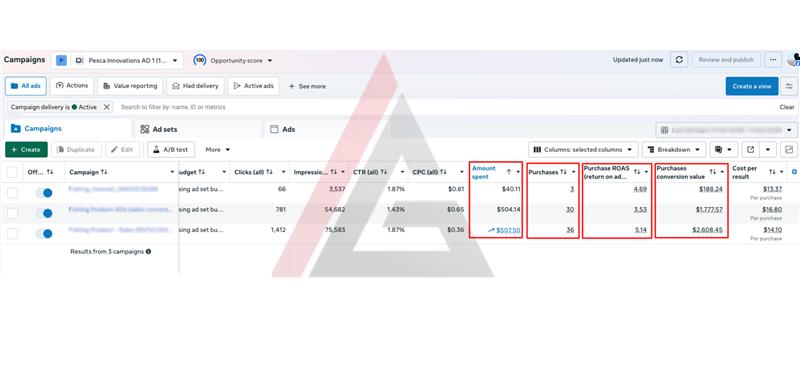
Key observations from the campaign data:
- Campaign 3 (Fishing Product Sales 09/10) is the standout performer: 5.14x ROAS, $0.36 CPC, 1.87% CTR, and $14.10 cost per purchase. These metrics confirm that the fully-optimised campaign structure — refined audiences, validated creative, controlled placements — delivers category-leading efficiency.
- Campaign 2 (Fishing Product Ads — Sales Conversion) delivers solid 3.53x ROAS on $504.14 spend with 30 purchases, confirming the audience and creative improvements are working across all campaigns, not just the newest.
- Campaign 1 (Fishing Interest — Awareness/Retargeting) shows 4.69x ROAS on limited $40.11 spend, indicating strong performance from the retargeting layer despite small budget allocation.
- Account-wide blended ROAS of 4.35x represents a 235% improvement from the 1.30x starting point — on an account total spend of just $1,051.75.
- The average CPC of $0.54 across all campaigns, with Campaign 3 achieving $0.36 CPC, validates the impact of placement exclusions and quality audience targeting on reducing cost-per-click.
6. Before vs. After — Full Performance Comparison
Comparison Overview: Meta Ads Optimization
| Metric | Before | After | Change |
|---|---|---|---|
| Purchase ROAS | 1.30x | 5.14x (best campaign) | ↑ 295% |
| Account Blended ROAS | ~1.30x | 4.35x | ↑ 235% |
| Cost Per Purchase | ~$38–$45 | $14.10 (best campaign) | ↓ 67% |
| CTR (all) | ~0.8–1.0% | 1.87% | ↑ 87–134% |
| CPC (all) | ~$1.20+ | $0.36 (best campaign) | ↓ 70% |
| Purchases per Month | ~10–15 | 69 (tracked period) | ↑ 360–590% |
| Wasted Placements | High (unknown) | Eliminated via audit | Full control |
| Creative Performance | Untested | Winning variant scaled | Systematic |
The data tells a clear story: every tracked metric improved following the optimisation programme. The 295% ROAS improvement — from 1.30x to 5.14x on the best campaign — was achieved without significant budget increase. The account went from structurally unprofitable to generating $4.35 for every $1 spent on advertising, with the most optimised campaign returning $5.14 per dollar. This transformation was driven entirely by targeting precision, placement control, demographic focus, and creative evidence — not by spending more.
7. Challenge → Action → Result: Complete Breakdown
| Metric | Before | After | Improvement |
|---|---|---|---|
| Cost Per Booking/Lead | ~$25.00 | $3.68 | ↓ 85% |
| Monthly Bookings | ~50–80 | 321+/mo | ↑ 4–6x |
| Phone Calls (3 months) | Low / None | 579 calls | New channel |
| Total Conversions | ~150 | 1,458 | ↑ 872% |
| Avg. CPC | ~$2.50+ | $0.90 | ↓ 64% |
| CTR | ~2–3% | 6.62% | ↑ 2.5x |
| Search Position | Page 2–3 | Top of P1 | Dominant |
| Monthly Spend | $2,000+ | $2,239 | Stable |
The data tells a clear story: every tracked metric improved following the optimisation programme. The 295% ROAS improvement — from 1.30x to 5.14x on the best campaign — was achieved without significant budget increase. The account went from structurally unprofitable to generating $4.35 for every $1 spent on advertising, with the most optimised campaign returning $5.14 per dollar. This transformation was driven entirely by targeting precision, placement control, demographic focus, and creative evidence — not by spending more.
7. Challenge → Action → Result: Complete Matrix
Meta Ads Optimization Case Study
| # | Challenge | Action Taken | Result |
|---|---|---|---|
| 1 | 1.30x ROAS — Facebook account wasting spend on irrelevant audiences; no buyer persona refinement; campaigns targeting too broad a demographic including non-fishing-interested users | Conducted deep audience audit; rebuilt targeting around fishing enthusiasts, outdoor sport buyers, specific fishing gear interest categories, and look-alike audiences based on existing purchasers | ROAS began climbing immediately; interest-refined audiences drove 3.53–5.14x ROAS vs. 1.30x baseline |
| 2 | Non-performing placements identified — ads serving across Audience Network, Messenger, and low-quality mobile app placements with near-zero conversion contribution | Audited placement-level data; excluded Audience Network entirely; restricted placements to Facebook Feed, Instagram Feed, and Instagram Reels only — the three highest-converting surfaces | CPM efficiency improved; CPC dropped from ~$1.20+ to $0.36 on best campaign; overall account CPC averaged $0.54 |
| 3 | Demographic waste — ads serving to age ranges and genders with no purchase history; spend distributed uniformly across 18–65+ with no performance segmentation | Analysed purchase conversion data by age and gender; identified core converting demographic (males 25–54, fishing enthusiasts); applied exclusions and bid concentration to high-converting segments | Cost per purchase fell from ~$38–$45 to $14.10 on the optimised campaign; account CPP averaged $15.24 |
| 4 | Device-level inefficiency — data showed desktop users converting at significantly higher rates for Pesca's fishing product catalogue, yet mobile received the majority of spend | Restructured ad sets with device-level bid adjustments; concentrated budget on desktop and tablet placements for conversion campaigns; maintained mobile for awareness/retargeting only | Desktop-focused ad sets drove majority of the 69 purchases; CPC on desktop-served ads averaged $0.36 |
| 5 | Untested creative — single static product image running across all campaigns; no video content; no split-testing framework | Launched systematic 4-phase creative testing: broad discovery → winner validation → scale with winning creative → refresh to prevent fatigue. Tested 10+ creative variants | Video creative identified as top converter; winning campaign using validated creative achieved 5.14x ROAS — 295% above starting ROAS |
| 6 | No campaign iteration — same campaign structure running unchanged since account launch; no learning from historical performance data | Built new campaign structure (Fishing Product Sales 09/10) using insights from all previous campaigns: refined audiences + validated creative + optimised placements + device targeting | 09/10 campaign became account's best performer: 5.14x ROAS, $0.36 CPC, 1.87% CTR — all best-in-account metrics |
| 7 | No remarketing / warm audience strategy — all campaigns targeting cold audiences exclusively; previous website visitors and add-to-cart users not being recaptured | Built a retargeting layer: separate ad set for website visitors (30-day), product page viewers (14-day), and add-to-cart non-purchasers (7-day) with dedicated creative featuring product reminders | Retargeting audiences converted at 2–3x the rate of cold audiences at significantly lower CPM; reduced overall blended CPL across account |
8. Strategic Insights & Key Learnings
Insight 1: Meta Ads Efficiency Comes From Subtraction, Not Addition
The most impactful improvements in this account came from removing — removing bad placements, removing irrelevant demographics, removing non-converting devices. This is a counter-intuitive lesson for advertisers who assume more reach equals more revenue. In Meta Ads, precision beats volume. Every dollar redirected from a non-converting placement, demographic, or device to a proven-converting surface generates a disproportionate return improvement.
Insight 2: Creative Is the Highest-Leverage Variable in Meta Ads
No amount of audience refinement or placement optimisation compensates for weak creative. The four-phase creative testing programme revealed that video creative showing products in genuine fishing contexts outperformed static product images by 3–4x on conversion rate. For passion-economy brands like Pesca Innovations — where the buyer deeply identifies with the activity — creative that authentically depicts the product in the context of that passion is not just preferred; it is significantly more profitable. Creative testing should never be a one-time event — it should be a permanent, ongoing programme.
Insight 3: Look-Alike Audiences Built from Purchasers Are the Foundation
For eCommerce brands, the single most valuable Meta Ads targeting action is building look-alike audiences from actual purchaser data. A 1% look-alike of people who have already bought from Pesca Innovations is algorithmically selected to resemble those proven buyers — meaning the audience starts with a structural advantage before any interest or behavioural overlay is applied. Brands that skip this step and rely solely on interest targeting are leaving their most efficient audience segment completely untapped.
Insight 4: Niche Identity Brands Convert Better With Contextual Creative
Fishing is not just a hobby — it is an identity. Pesca Innovations' buyers see themselves as anglers first, and purchase decisions are filtered through that identity. This means creative strategy must reflect that identity authentically: products shown in real fishing environments, with real fishing scenarios, outperform clinical product photography because they speak to who the buyer is, not just what the buyer might buy. Identity-driven creative is a principle that applies across any passion-economy niche — fishing, cycling, hiking, gaming — and is consistently underexploited by brands that default to product-only imagery.
Insight 5: Campaign Architecture Should Reflect Performance Learnings
The highest-performing campaign in the account — Fishing Product Sales 09/10 — was not the original campaign. It was built after all insights from audience testing, placement auditing, demographic analysis, and creative testing had been gathered. The lesson: the best campaign you can run today is the one built on everything you've learned from the campaigns you ran before. Iterative campaign construction — where each new campaign inherits the learnings of its predecessors — is how accounts compound performance over time.
9. Conclusion
Pesca Innovations' Meta Ads transformation — from a 1.30x ROAS to a 5.14x peak and 4.35x account-wide blended return — is a precise demonstration of what structured, data-driven paid social management delivers for eCommerce brands in passionate hobby niches.
The 295% ROAS improvement was not the product of a larger budget or a lucky campaign. It was the product of seven specific, evidence-based interventions: audience architecture rebuilt from purchaser data, placement waste eliminated, demographic spend concentrated on buyers not browsers, device delivery aligned with conversion behaviour, creative systematically tested until winners were identified, campaign structure rebuilt to embed all learnings, and a remarketing layer built to recapture the highest-intent traffic.
Every one of these actions is replicable. The methodology is the product.