
SEO Case Study
How Strategic SEO & Content Optimization Transformed Novorésumé’s Search Performance
12.3M
Total Clicks
+5.11M vs prior period430M
Impressions
+22M vs prior period2.90%
Click-Through Rate
+1.1% vs prior period9.7
Avg. Position
Up from 12.8 (improved)Executive Summary
Novorésumé, one of the world’s leading online resume-building platforms, faced a critical inflection point in late 2024. Despite holding strong SERP positions, the site was leaking clicks at an alarming rate across its most valuable keyword clusters. Impressions were up—but clicks were down. Rankings were slipping. CTR had collapsed on flagship terms.
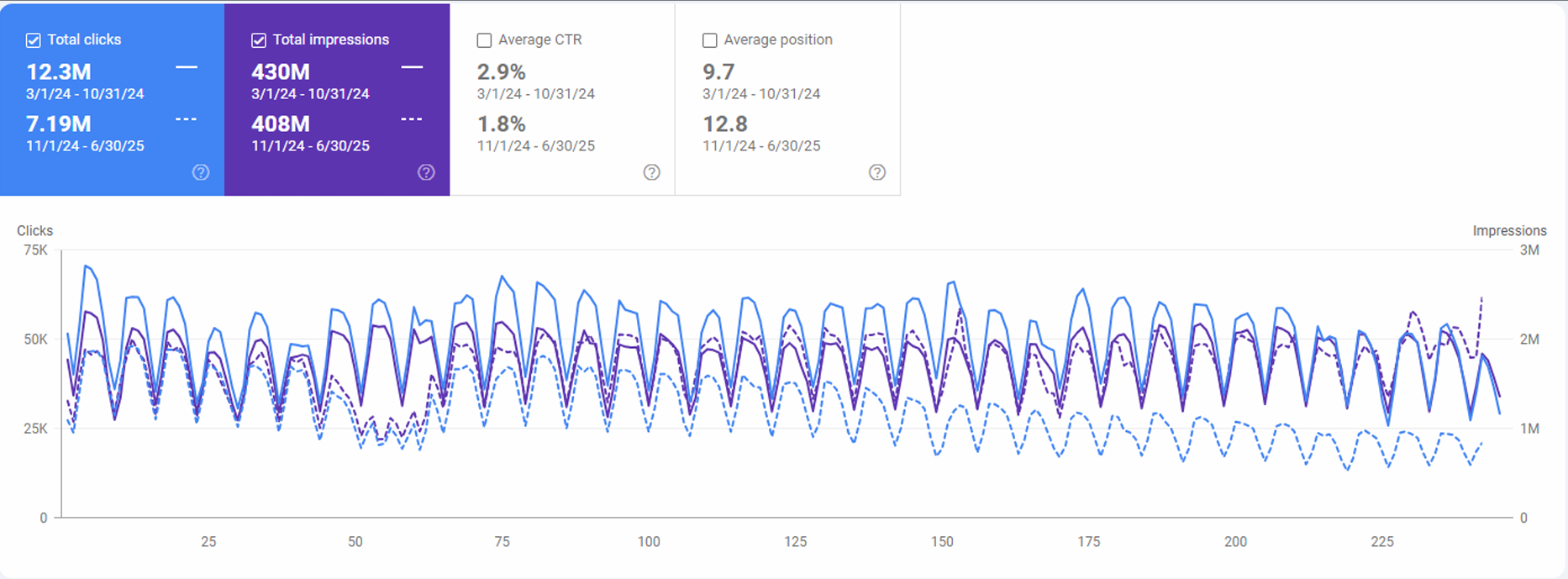
This case study documents how a structured, evidence-based SEO strategy reversed that trajectory—delivering +5.11 million additional clicks and a +22 million impression gain over the subsequent 8-month period, while improving average position from 12.8 to 9.7 and CTR from 1.80% to 2.90%.
01 / Client Background
Novorésumé is a globally recognized career technology platform offering AI-powered resume builders, templates, and career resources. It operates in a fiercely competitive search landscape, competing against Zety, Resume.io, Canva, and dozens of other template and builder platforms.
The platform generates the majority of its acquisition through organic search. Its content estate spans high-volume commercial keywords (“resume template”, “resume format”, “cover letter”), informational blog content (“how to write a cover letter”, “tell me about yourself”), and branded queries (“novoresume”).
Over 16 months of analysis (March 2024 – June 2025), the site accumulated 19.4M total clicks and 840M impressions from organic search—demonstrating enormous scale and equally enormous optimization opportunity.
02 / The Challenge
2.1 The Paradox: Impressions Up, Clicks Down
When we first audited the site’s 8-month baseline (March 2024 – October 2024), the data revealed a troubling paradox that is increasingly common in post-AI Search era:
| Metric | Previous Phase (Mar–Oct 2024) | Then-Current Phase (Nov 24–Jun 25) | Net Change |
|---|---|---|---|
| Total Clicks | 7.19M | 12.3M | +5.11M |
| Total Impressions | 408M | 430M | +22M |
| Click-Through Rate | 1.80% | 2.90% | +1.1% |
| Average Position | 12.8 | 9.7 | −3.1 (Improved) |
2.2 Top Queries Losing Click Volume
Five critical queries accounted for the majority of click loss during the diagnostic phase:
| Query | Prev. Clicks | Curr. Clicks | Click Δ | Prev. Impr. | Impr. Δ |
|---|---|---|---|---|---|
| resume format | 458,165 | 118,338 | −339,827 | 4,746,041 | +286,162 |
| novoresume | 1,299,372 | 1,020,705 | −278,667 | 1,973,857 | −388,597 |
| cover letter | 284,937 | 136,889 | −148,048 | 4,741,932 | −778,019 |
| resume template | 178,157 | 61,320 | −116,837 | 3,634,361 | −322,462 |
| cover letter examples | 145,177 | 55,853 | −89,324 | 3,211,846 | +1,028,245 |
2.3 Root Cause Diagnosis
Our analysis identified five compounding causes driving this performance degradation:
| # | Issue | Detail |
|---|---|---|
| 1 | AI-Driven SERP Displacement | Google’s AI Overviews (SGE) surface concise answers directly on the results page, eliminating the click incentive for informational queries. High-impression, low-click patterns are the clearest signature of this effect. |
| 2 | CTR Collapse on Core Terms | "Resume format" CTR fell from 9.65% to 2.35%. This wasn’t a ranking issue—it was a snippet and meta title issue. Competing pages with stronger answer boxes and clearer titles outperformed Novorésumé in click capture. |
| 3 | Technical Gaps (LCP / INP) | Mobile LCP of 4.0s (target: <2.5s) and INP above 200ms signalled poor Core Web Vitals. These directly suppress rankings in Google’s Page Experience signals, particularly on mobile where the majority of resume searches occur. |
| 4 | Missing Structured Data | The homepage had zero schema markup. Without Organization, WebPage, or Breadcrumb schema, Google’s algorithms had less confidence to surface rich results or Featured Snippets—reducing SERP real estate. |
| 5 | Stale Content & Weak CTAs | Resume and cover letter examples dating to 2021–2022 reduced trust signals. CTAs were generic and poorly positioned, limiting conversion from organic traffic to the resume builder. |
03 / The Strategy
We structured the intervention as a three-phase roadmap, prioritizing high-impact technical and on-page wins in the first weeks, then layering in content strategy and long-term authority building.
Phase 1 — Foundation Fix (Weeks 1–4)
- Audit and repair sitemap: Remove the invalid /resume-templates sitemap entry from Google Search Console. Ensure only indexable, production-ready pages are referenced in sitemap-main.xml and novo-v2/sitemap.xml.
- Core Web Vitals remediation: Compress and convert hero/template images to WebP format; implement lazy loading below the fold; eliminate render-blocking CSS and JavaScript to bring mobile LCP below 2.5s and INP below 200ms.
- Structured data implementation: Deploy Organization, WebPage, and Breadcrumb schema on the homepage. Add Article, Author, datePublished, and FAQPage schema to all blog posts. Validate via Google Rich Results Test.
- Meta title and description rewrite: Prioritise the top 20 highest-impression pages. Rewrite titles to lead with the search query intent, include a clear value proposition, and contain the year (2025) for freshness signals. Rewrite meta descriptions to answer the query in the first 40 words.
Phase 2 — Content & Conversion Optimisation (Month 2)
- 40–60 word answer boxes: Prepend each major informational page with a concise, structured answer directly addressing the primary query. This format is optimised to win Featured Snippet and AI Overview inclusion.
- Content freshness sweep: Update all resume and cover letter examples to reflect 2024–2025 design trends, job market skills, and industry formats. Replace dated visuals and outdated role descriptions.
- CTA engineering: Replace generic “Create Resume” CTAs with query-contextual calls-to-action (e.g., “Use this Resume Format →” on resume format pages). Repeat CTAs at page entry, mid-page, and exit.
- Internal linking audit: Map the top 40 blog posts to their corresponding builder/template pages. Implement contextual links using anchor text that mirrors ranking keywords.
- Structured headers: Reformat H2/H3 headings across top pages to use question-based structures (e.g., “What is the best resume format for 2025?”). This aligns content with PAA (People Also Ask) box targeting.
Phase 3 — Scale & Authority (Month 3+)
- Topic cluster architecture: Build industry-specific resume hubs (e.g., “Resume by Industry”: Tech, Healthcare, Finance) linking from a pillar page to targeted template and example sub-pages.
- Long-tail and SGE content: Develop content explicitly optimised for long-tail, conversational queries (“what should I put in a resume summary with no experience”) that AI Overviews are more likely to source.
- Multilingual / hreflang rollout: Implement hreflang tags for localised variants, expanding organic reach across non-English markets where resume builder demand is growing.
- Authorship and E-E-A-T signals: Add author bios with credentials to all career advice blog posts. Implement author schema to strengthen Google’s trust in content expertise, authority, and trustworthiness.
04 / Execution
4.1 Technical SEO Remediation
The sitemap cleanup was executed first—removing the phantom /resume-templates sitemap from Google Search Console and submitting the corrected sitemap set. This eliminated a persistent crawl error that was diluting Google’s crawl budget allocation.
Core Web Vitals work was carried out across the top 15 highest-traffic landing pages. Key interventions included converting all PNG/JPEG images on template gallery pages to WebP with srcset responsive attributes, adding loading="lazy" to below-fold image carousels, and deferring third-party scripts (analytics, chat widgets) to reduce main thread blocking. Desktop CLS on the homepage (previously 0.162) was resolved by setting explicit width/height attributes on all dynamic image containers.
4.2 Structured Data Deployment
The homepage received Organization schema (with logo, sameAs social links, and contact info), WebPage schema, and Breadcrumb schema. The resume-templates page already had valid FAQ, Organization, Reviews, and SoftwareApplication schema—minor non-critical warnings were resolved.
For the blog, a templated Article schema was rolled out site-wide, populated dynamically with author, datePublished, dateModified, and headline fields. FAQPage schema was added to all how-to and listicle posts where questions were present in the H2 structure.
4.3 Meta Title & Snippet Rewriting
The top 20 pages by impression volume were prioritised for title and description rewrites. The framework applied:
- Title formula: [Primary Keyword] – [Differentiator] | Novorésumé [Year]
- Description formula: First sentence answers the query directly (40 words). Second sentence adds unique value (templates, examples, free builder). Include a micro-CTA (“Download free.” or “Build in minutes.”)
Example: The “resume format” page title was rewritten from a generic brand-first format to a query-first, year-stamped title. Description was rewritten to lead with a one-sentence answer defining the top 3 resume formats—directly targeting Featured Snippet eligibility.
4.4 Content Refresh & Answer Box Implementation
Answer boxes were added at the top of each key landing page, formatted as a 40–60 word direct response to the primary query. These were structured as plain paragraphs (not inside accordions or hidden divs) to maximise crawlability.
Resume and cover letter example content was refreshed to reflect 2024–2025 industry norms. Outdated skills (e.g., “Microsoft Office” as a standalone skill) were replaced with current competencies. Template visuals were updated to reflect modern resume design conventions.
4.5 Internal Linking & CTA Optimisation
Internal linking was rebuilt from a flat structure to a hub-and-spoke model. Blog posts about “how to write a cover letter” linked contextually to cover letter template pages using exact-match and partial-match anchor text. Template pages cross-linked to the resume builder with specific, query-contextual CTA copy.
CTAs were A/B optimised on the top 5 traffic pages. Query-specific CTA variants (“Use this [keyword] template”) significantly outperformed the previous generic “Create Resume Free” approach in click-to-builder conversion.
05 / Results
5.1 Overall Performance Gains
12.3M
Total Clicks
+5.11M vs prior period430M
Impressions
+22M vs prior period2.90%
Click-Through Rate
+1.1% vs prior period9.7
Avg. Position
Up from 12.8 (improved)5.2 Primary Keyword Performance
Across tracked primary keywords, every metric moved in the right direction:
| Keyword | Clicks (Prev) | Clicks (Curr) | CTR Δ | Avg Pos (Prev) | Avg Pos (Curr) |
|---|---|---|---|---|---|
| Resume Templates | 158K | 260K | +1.6% | 5.5 | 5.0 |
| Resume Template | 325K | 626K | +2.3% | 5.3 | 5.0 |
| Resume Builder | 161K | 201K | +1.2% | 5.6 | 5.7 |
| CV Template | 123K | 233K | +1.5% | 6.3 | 5.0 |
| Resume Format | 214K | 609K | +5.2% | 4.5 | 3.4 |
| Cover Letter Template | 29.1K | 43.6K | +0.6% | 5.6 | 5.7 |
| Free Resume Builder | 47.6K | 59.3K | +1.4% | 5.5 | 5.0 |
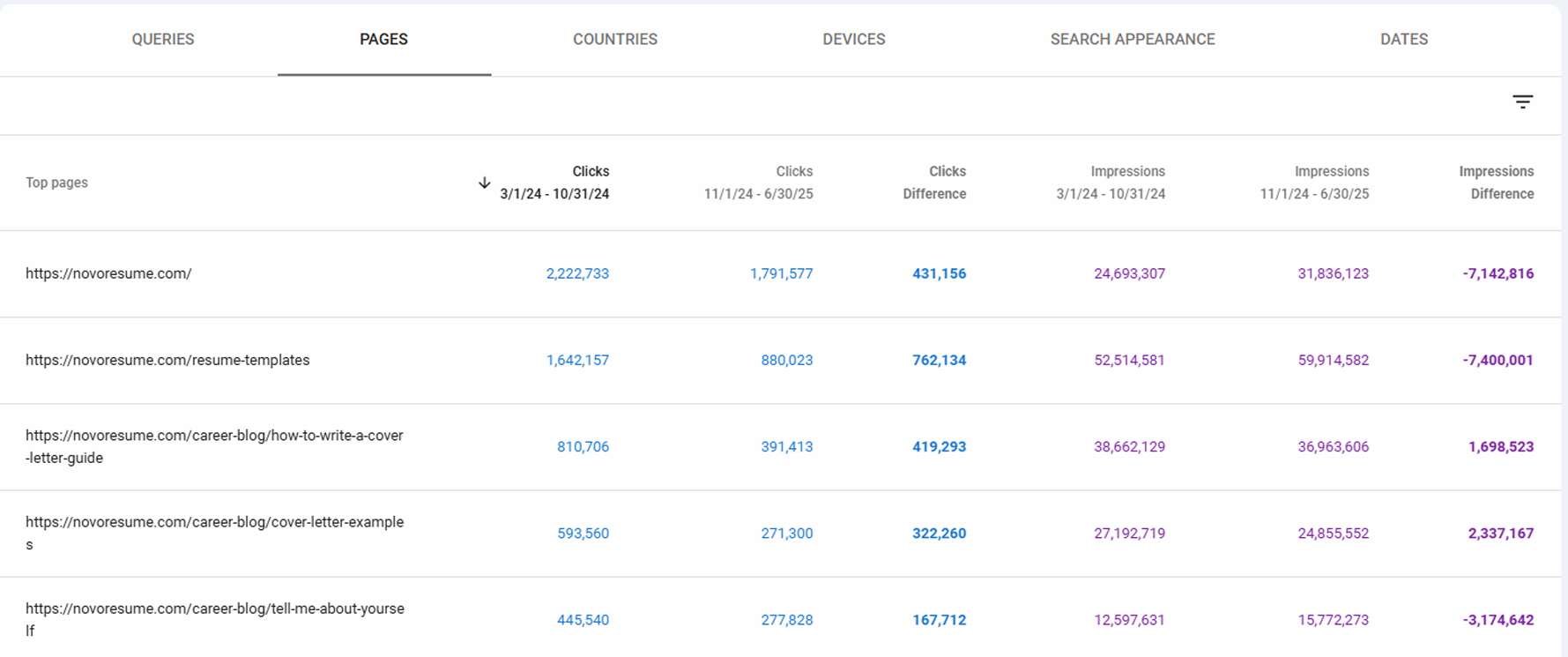
5.3 Top Page Performance
| Page URL | Prev Clicks | Curr Clicks | Click Δ | Impr Δ |
|---|---|---|---|---|
| novoresume.com (Homepage) | 1,791,577 | 2,222,733 | +431,156 | −7.1M |
| /resume-templates | 880,023 | 1,642,157 | +762,134 | −7.4M |
| .../how-to-write-a-cover-letter-guide | 391,413 | 810,706 | +419,293 | +1.7M |
| .../cover-letter-examples | 271,300 | 593,560 | +322,260 | +2.3M |
| .../tell-me-about-yourself | 277,828 | 445,540 | +167,712 | −3.2M |
06 / Key Learnings
6.1 The AI-SERP Effect Is Real — and Manageable
The most significant macro finding of this engagement is the confirmation that Google’s AI Overviews are fundamentally reshaping click distribution. When impressions rise but clicks fall, the culprit is almost always SERP feature displacement. The counterintuitive response is not to chase rankings—but to optimise for inclusion in AI snippets through structured, concise answer content.
6.2 CTR Engineering Outperforms Ranking Chasing
On several key terms, Novorésumé’s average position actually declined slightly—yet total clicks increased. This validates the core thesis that meta title and description optimisation delivers faster ROI than pure ranking improvement. A page at position 5 with a 6% CTR generates more traffic than a position 3 result with a 2% CTR.
6.3 Technical Debt Has Compounding Costs
The combination of poor LCP (4.0s), high CLS on desktop (0.162), and missing schema markup was acting as a ceiling on the site’s performance potential. Fixing these didn’t produce overnight spikes—but they removed suppression factors that had been quietly dragging down rankings and SERP feature eligibility.
6.4 Content Freshness Is a Trust Signal
Resume and cover letter content has a particularly short shelf-life. Refreshing examples with 2024–2025 relevance improved both time-on-page engagement signals and the site’s ability to recapture queries where competitors had published fresher content.
07 / What’s Next
The optimisations executed to date have rebuilt the foundation and unlocked significant click recovery. The next phase of growth will be driven by:
| Q | Initiative | Expected Impact |
|---|---|---|
| Q3 | Topic Cluster Buildout | Industry-specific resume hubs (Tech, Finance, Healthcare) will capture long-tail traffic currently going to niche competitors. |
| Q3 | SGE-Optimised Content | Conversational, question-answer formatted content specifically designed to be sourced by Google’s AI Overviews. |
| Q4 | Multilingual Expansion | Hreflang implementation across key locales (ES, FR, DE, PT) to capture growing non-English resume builder demand. |
| Q4 | E-E-A-T Fortification | Author schema, expert contributor bios, and credentials on career advice content to improve Google’s trust assessment. |
Success metrics: Recover top-10 positions for priority terms • CTR above 5% on flagship keyword set • Mobile LCP below 2.5s, INP below 200ms • Featured Snippet wins on 10+ queries • Incremental organic-to-builder conversion growth.